Skip to main content
GOB Chemistry
나의 코스
배우기
시험 준비
AI 튜터
학습 가이드
교과서적 해결책
플래시카드
탐험해 보세요
앱을 사용해 보세요
나의 코스
배우기
시험 준비
AI 튜터
학습 가이드
교과서적 해결책
플래시카드
탐험해 보세요
앱을 사용해 보세요
뒤로
Bond Angles (Simplified) quiz
카드를 뒤집기 위해 탭할 수 있습니다.
What is a bond angle in a molecule?
카드를 뒤집기 위해 탭할 수 있습니다.
👆
What is a bond angle in a molecule?
A bond angle is the angle formed by two adjacent neighboring atoms in a molecule, measured at the central atom.
진행 상황 추적
컨트롤 버튼이 '내비게이션' 모드로 변경되었습니다.
1/15
관련 플래시카드
관련 실천
추천 영상
Bond Angles (Simplified) definitions
Bond Angles (Simplified)
14 용어
Bond Angles (Simplified)
4. Molecular Compounds
2 문제점
주제
Jules
Dipole Moment (Simplified)
4. Molecular Compounds
7 문제점
주제
Jules
4. Molecular Compounds - Part 1 of 3
8 주제
13 문제점
장
Jules
4. Molecular Compounds - Part 2 of 3
8 주제
14 문제점
장
Jules
4. Molecular Compounds - Part 3 of 3
1 주제
2 문제점
장
VideoThumbView.guidedCourse
01:24
Bond Angles (Simplified) Example 1
3407
views
5
rank
VideoThumbView.guidedCourse
02:14
Bond Angles (Simplified) Concept 2
3264
views
7
rank
VideoThumbView.guidedCourse
01:24
Bond Angles (Simplified) Concept 1
3516
views
9
rank
이 집합의 용어 (15)
하이드의 정의
What is a bond angle in a molecule?
A bond angle is the angle formed by two adjacent neighboring atoms in a molecule, measured at the central atom.
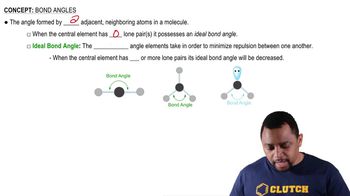
How does the presence of lone pairs on the central atom affect bond angles?
Lone pairs on the central atom decrease the bond angle from its ideal value due to increased electron repulsion.
What is meant by an 'ideal bond angle'?
An ideal bond angle occurs when the central atom has zero lone pairs, minimizing repulsion between bonding electron groups.
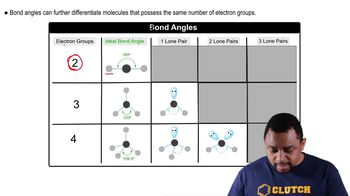
What is the ideal bond angle for a molecule with two electron groups?
The ideal bond angle for two electron groups is 180°, as there are no lone pairs possible.
What is the ideal bond angle for a molecule with three electron groups and no lone pairs?
The ideal bond angle for three electron groups with no lone pairs is 120°.
How does the bond angle change when there is one lone pair among three electron groups?
The bond angle decreases from the ideal 120° and is less than 120° when there is one lone pair.
What is the ideal bond angle for a molecule with four electron groups and no lone pairs?
The ideal bond angle for four electron groups with no lone pairs is 109.5°.
How does the bond angle change with one lone pair among four electron groups?
The bond angle decreases from the ideal 109.5° and is less than 109.5° when there is one lone pair.
What happens to the bond angle when there are two lone pairs among four electron groups?
The bond angle becomes even less than 109.5°, decreasing further due to the presence of two lone pairs.
Why do lone pairs cause bond angles to decrease?
Lone pairs cause bond angles to decrease because they create greater electron repulsion than bonding pairs.
How can bond angles help differentiate molecules with the same number of electron groups?
Bond angles can differentiate molecules because the presence and number of lone pairs affect the actual bond angle.
What is the bond angle for a molecule with two bonding groups and one lone pair among three electron groups?
The bond angle is less than 120° due to the lone pair's repulsion.
What is the bond angle for a molecule with two bonding groups and two lone pairs among four electron groups?
The bond angle is less than 109.5°, and even smaller than with just one lone pair.
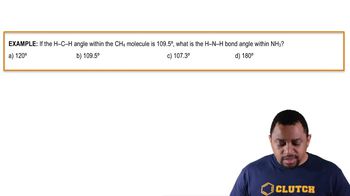
What is the general trend for bond angles as the number of lone pairs increases?
As the number of lone pairs increases, the bond angle decreases further from its ideal value.
What is the relationship between lone pairs and electron repulsion in determining bond angles?
Lone pairs increase electron repulsion, which causes bond angles to decrease from their ideal values.
 뒤로뒤로
뒤로뒤로
 01:24
01:24