Skip to main content
GOB Chemistry
나의 코스
배우기
시험 준비
AI 튜터
학습 가이드
교과서적 해결책
플래시카드
탐험해 보세요
앱을 사용해 보세요
나의 코스
배우기
시험 준비
AI 튜터
학습 가이드
교과서적 해결책
플래시카드
탐험해 보세요
앱을 사용해 보세요
뒤로
Bonding Preferences quiz
카드를 뒤집기 위해 탭할 수 있습니다.
What is the preferred number of bonds for elements in groups 1a to 4a?
카드를 뒤집기 위해 탭할 수 있습니다.
👆
What is the preferred number of bonds for elements in groups 1a to 4a?
The preferred number of bonds is equal to their group number.
진행 상황 추적
컨트롤 버튼이 '내비게이션' 모드로 변경되었습니다.
1/15
관련 플래시카드
관련 실천
추천 영상
Bonding Preferences definitions
Bonding Preferences
13 용어
Bonding Preferences
4. Molecular Compounds
3 문제점
주제
Jules
Lewis Dot Structures: Neutral Compounds (Simplified)
4. Molecular Compounds
6 문제점
주제
Jules
4. Molecular Compounds - Part 1 of 3
8 주제
13 문제점
장
Jules
4. Molecular Compounds - Part 2 of 3
8 주제
14 문제점
장
Jules
4. Molecular Compounds - Part 3 of 3
1 주제
2 문제점
장
VideoThumbView.guidedCourse
03:16
Bonding Preferences Concept 1
4660
views
25
rank
VideoThumbView.guidedCourse
00:56
Bonding Preferences Example 1
4321
views
21
rank
이 집합의 용어 (15)
하이드의 정의
What is the preferred number of bonds for elements in groups 1a to 4a?
The preferred number of bonds is equal to their group number.
Why should hydrogen never be placed at the center when drawing molecular compounds?
Hydrogen can only form one bond and cannot accommodate more than two electrons, so it is never central.
How many bonds does carbon (group 4a) prefer to form?
Carbon prefers to form four bonds, even bonding with itself if necessary.
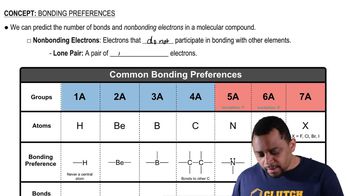
What is the rule for determining bonding preferences for groups 5a to 7a?
The number of bonds equals the number of electrons needed to achieve a stable electron configuration, following the octet rule.
How many bonds does nitrogen (group 5a) typically form?
Nitrogen forms three bonds to reach eight valence electrons.
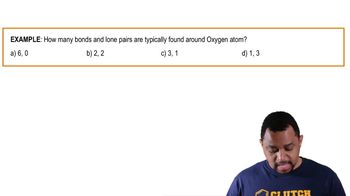
How many bonds does oxygen (group 6a) typically form?
Oxygen forms two bonds to achieve a full octet.
How many bonds do halogens (group 7a) typically form?
Halogens typically form one bond to gain the one additional electron needed for a total of eight valence electrons.
What is a lone pair in the context of bonding preferences?
A lone pair is a pair of nonbonding electrons that do not participate in bonding with other elements.
How many lone pairs does nitrogen have as a surrounding element?
Nitrogen has one lone pair as a surrounding element.
How many lone pairs does oxygen have as a surrounding element?
Oxygen has two lone pairs as a surrounding element.
How many lone pairs do halogens have as surrounding elements?
Halogens have three lone pairs as surrounding elements.
Do elements in groups 1a to 4a have lone pairs when bonding?
No, elements in groups 1a to 4a do not have lone pairs when bonding.
What variable is used to represent halogens in group 7a?
The variable 'X' is used to represent halogens such as fluorine, chlorine, bromine, and iodine.
How do group 1a to 4a elements determine their preferred number of bonds?
They determine their preferred number of bonds based on their group number.
What is the significance of the octet rule in bonding preferences for groups 5a to 7a?
The octet rule guides these elements to form enough bonds to reach eight valence electrons for stability.
 뒤로뒤로
뒤로뒤로
 03:16
03:16