Skip to main content
GOB Chemistry
나의 코스
배우기
시험 준비
AI 튜터
학습 가이드
교과서적 해결책
플래시카드
탐험해 보세요
앱을 사용해 보세요
나의 코스
배우기
시험 준비
AI 튜터
학습 가이드
교과서적 해결책
플래시카드
탐험해 보세요
앱을 사용해 보세요
뒤로
Periodic Trend: Ranking Ionic Radii definitions
카드를 뒤집기 위해 탭할 수 있습니다.
Ionic Radius
카드를 뒤집기 위해 탭할 수 있습니다.
👆
Ionic Radius
Distance from the nucleus to the outermost electron in an ion, influenced by electron count and ionic charge.
진행 상황 추적
컨트롤 버튼이 '내비게이션' 모드로 변경되었습니다.
1/15
관련 플래시카드
관련 실천
추천 영상
Periodic Trend: Ranking Ionic Radii quiz
Periodic Trend: Ranking Ionic Radii
15 용어
Periodic Trend: Ranking Ionic Radii
3. Ionic Compounds
4 문제점
주제
Periodic Trend: Ionization Energy (Simplified)
3. Ionic Compounds
4 문제점
주제
Jules
3. Ionic Compounds - Part 1 of 3
5 주제
10 문제점
장
Jules
3. Ionic Compounds - Part 2 of 3
7 주제
11 문제점
장
Jules
3. Ionic Compounds - Part 3 of 3
2 주제
4 문제점
장
VideoThumbView.guidedCourse
03:07
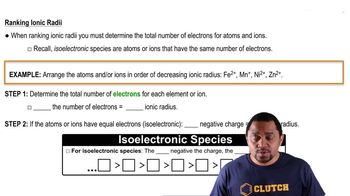
Periodic Trend: Ranking Ionic Radii Concept 1
5632
views
28
rank
이 집합의 용어 (15)
하이드의 정의
Ionic Radius
Distance from the nucleus to the outermost electron in an ion, influenced by electron count and ionic charge.
Isoelectronic Species
Atoms or ions possessing identical numbers of electrons, often compared by charge to determine size differences.
Atomic Number
Unique value representing the number of protons in an atom, used to determine electron count in neutral atoms.
Electron Count
Total number of electrons present in an atom or ion, crucial for predicting relative ionic sizes.
Charge
Numerical indication of electron loss or gain in an ion, affecting ionic radius especially among isoelectronic species.
Cation
Positively charged ion formed by electron loss, typically resulting in a smaller ionic radius compared to the neutral atom.
Anion
Negatively charged ion formed by electron gain, generally exhibiting a larger ionic radius than the neutral atom.
Neutral Atom
Species with equal numbers of protons and electrons, serving as a reference for changes in ionic size.
Decreasing Order
Arrangement from largest to smallest, often used to rank ionic radii based on electron count and charge.
Positive Charge
State resulting from electron loss, leading to a reduced ionic radius among isoelectronic ions.
Negative Charge
State resulting from electron gain, causing an increase in ionic radius among isoelectronic ions.
Iron(II) Ion
Species with 24 electrons and a +2 charge, smaller than isoelectronic ions with less positive charge.
Manganese(I) Ion
Species with 24 electrons and a +1 charge, larger than isoelectronic ions with a higher positive charge.
Zinc(II) Ion
Ion with 28 electrons, possessing the largest ionic radius among the compared transition metal ions.
Nickel(II) Ion
Ion with 26 electrons, intermediate in ionic radius among the listed transition metal ions.
 뒤로뒤로
뒤로뒤로
 03:07
03:07