Skip to main content
GOB Chemistry
나의 코스
배우기
시험 준비
AI 튜터
학습 가이드
교과서적 해결책
플래시카드
탐험해 보세요
앱을 사용해 보세요
나의 코스
배우기
시험 준비
AI 튜터
학습 가이드
교과서적 해결책
플래시카드
탐험해 보세요
앱을 사용해 보세요
뒤로
Periodic Trend: Ranking Ionic Radii quiz
카드를 뒤집기 위해 탭할 수 있습니다.
What is the first step in ranking ionic radii of atoms or ions?
카드를 뒤집기 위해 탭할 수 있습니다.
👆
What is the first step in ranking ionic radii of atoms or ions?
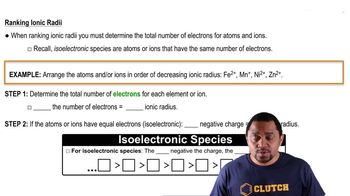
Determine the total number of electrons for each atom or ion.
진행 상황 추적
컨트롤 버튼이 '내비게이션' 모드로 변경되었습니다.
1/15
관련 플래시카드
관련 실천
추천 영상
Periodic Trend: Ranking Ionic Radii definitions
Periodic Trend: Ranking Ionic Radii
15 용어
Periodic Trend: Ranking Ionic Radii
3. Ionic Compounds
4 문제점
주제
Periodic Trend: Ionization Energy (Simplified)
3. Ionic Compounds
4 문제점
주제
Jules
3. Ionic Compounds - Part 1 of 3
5 주제
10 문제점
장
Jules
3. Ionic Compounds - Part 2 of 3
7 주제
11 문제점
장
Jules
3. Ionic Compounds - Part 3 of 3
2 주제
4 문제점
장
VideoThumbView.guidedCourse
03:07
Periodic Trend: Ranking Ionic Radii Concept 1
5631
views
28
rank
이 집합의 용어 (15)
하이드의 정의
What is the first step in ranking ionic radii of atoms or ions?
Determine the total number of electrons for each atom or ion.
How does the number of electrons affect the ionic radius?
More electrons generally result in a larger ionic radius.
What are isoelectronic species?
Isoelectronic species are atoms or ions that have the same number of electrons.
When comparing isoelectronic species, what factor determines which has the larger ionic radius?
The species with the more negative charge has the larger ionic radius.
How many electrons does a neutral iron (Fe) atom have?
A neutral iron atom has 26 electrons.
How many electrons does an Fe 2+ ion have?
An Fe 2+ ion has 24 electrons.
How many electrons does a Mn+1 ion have?
A Mn+1 ion has 24 electrons.
How many electrons does a Ni 2+ ion have?
A Ni 2+ ion has 26 electrons.
How many electrons does a Zn 2+ ion have?
A Zn 2+ ion has 28 electrons.
Which ion among Fe 2+, Mn+1, Ni 2+, and Zn 2+ has the largest ionic radius?
Zn 2+ has the largest ionic radius because it has the most electrons.
Between Fe 2+ and Mn+1, which has the larger ionic radius and why?
Mn+1 has the larger ionic radius because it has a less positive charge, even though both have 24 electrons.
What is the general trend for ionic radius with respect to charge among isoelectronic species?
The more negative the charge, the larger the ionic radius.
How do you arrange ions in order of decreasing ionic radius?
List them from the one with the most electrons to the least, using charge to break ties among isoelectronic species.
If two ions have the same number of electrons, what should you compare next?
Compare their charges; the ion with the more negative (or less positive) charge is larger.
What is the order of ionic radius for the ions Zn 2+, Ni 2+, Mn+1, and Fe 2+ from largest to smallest?
Zn 2+ > Ni 2+ > Mn+1 > Fe 2+.
 뒤로뒤로
뒤로뒤로
 03:07
03:07