 뒤로
뒤로Acids and Bases: Bronsted-Lowry Theory and Properties
스터디 가이드 - 스마트 노트
 자료에 맞춘 맞춤형 노트, 핵심 정의, 예시, 맥락을 확장해 제공합니다.
Acids and Bases (Bronsted-Lowry Acids and Bases)
Introduction to Acids and Bases
Acids and bases are fundamental chemical species with distinct properties and behaviors in aqueous solutions. Their definitions have evolved to include a broader range of substances, especially with the Bronsted-Lowry theory.
What are Acids?
Definition and Properties
Acids are substances that produce hydrogen ions (H+) when dissolved in water.
They typically have a sour taste (e.g., vinegar, lemon juice).
Acids turn blue litmus paper red and can corrode some metals.
They are characterized by their ability to donate protons (H+ ions).
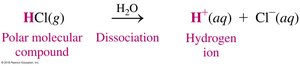
Naming Acids
Simple Anions: If the acid contains a simple nonmetal anion, use the prefix "hydro-" and the suffix "-ic acid." Example: HCl (aq) → hydrochloric acid
Polyatomic Ions:
If the polyatomic ion ends in "-ate," use "-ic acid." Example: HNO3 (nitrate) → nitric acid
If the polyatomic ion ends in "-ite," use "-ous acid." Example: HNO2 (nitrite) → nitrous acid
What is a Base?
Definition and Properties
Bases are ionic compounds that dissociate into cations and hydroxide ions (OH-) in water.
Most bases are formed from Group 1 and Group 2 metals (e.g., NaOH, KOH, Ca(OH)2).
Bases have a bitter taste and a slippery feel.
Bases turn litmus paper blue and phenolphthalein indicator pink.
Naming Bases
Name the metal first, followed by "hydroxide." Examples: LiOH → lithium hydroxide, NaOH → sodium hydroxide

Bronsted-Lowry Acids and Bases
Expanded Definitions
The Bronsted-Lowry theory (1923) defines acids and bases based on proton transfer, not just the presence of hydroxide ions.
Bronsted-Lowry Acid: Proton (H+) donor
Bronsted-Lowry Base: Proton (H+) acceptor
In aqueous solutions, free hydrogen ions do not exist independently; they associate with water molecules to form the hydronium ion (H3O+).
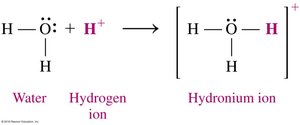
Examples of Bronsted-Lowry Acid-Base Reactions
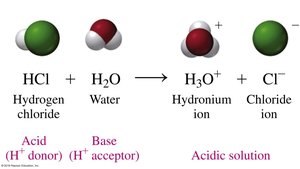
HCl + H2O → H3O+ + Cl- - HCl is the acid (proton donor), H2O is the base (proton acceptor).
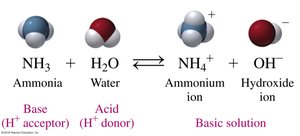
NH3 + H2O ⇌ NH4+ + OH- - H2O is the acid (proton donor), NH3 is the base (proton acceptor).
Conjugate Acid-Base Pairs
Definition and Identification
In every acid-base reaction, two conjugate acid-base pairs are present. These pairs differ by one proton (H+).
The acid loses a proton to become its conjugate base.
The base gains a proton to become its conjugate acid.
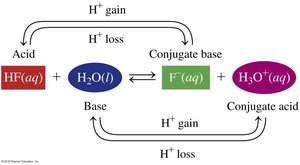
Example: In the reaction HF + H2O ⇌ F- + H3O+:
HF (acid) / F- (conjugate base)
H2O (base) / H3O+ (conjugate acid)
Strength of Acids and Bases
Strong vs. Weak Acids
Strong acids dissociate completely in water, producing a high concentration of H3O+ ions.
Weak acids only partially dissociate, producing fewer H3O+ ions.
Strong vs. Weak Bases
Strong bases dissociate completely in water, yielding a high concentration of OH- ions.
Weak bases are poor acceptors of H+ and produce few ions in solution.
Summary Table: Properties of Acids and Bases
Property | Acids | Bases |
|---|---|---|
Ion produced in water | H+ (or H3O+) | OH- |
Taste | Sour | Bitter |
Litmus test | Turns blue litmus red | Turns red litmus blue |
Feel | May corrode metals | Slippery |
Examples | HCl, H2SO4, HNO3 | NaOH, KOH, Ca(OH)2 |
Key Equations
Acid dissociation:
Base dissociation:
References
Timberlake, K. (2018). Chemistry: Introduction to General, Organic, and Biological Chemistry (13th ed). Pearson Education.
