 뒤로
뒤로Acids and Bases: Bronsted-Lowry Theory and Properties
스터디 가이드 - 스마트 노트
 자료에 맞춘 맞춤형 노트, 핵심 정의, 예시, 맥락을 확장해 제공합니다.
Acids and Bases: Bronsted-Lowry Theory and Properties
Introduction to Acids and Bases
Acids and bases are fundamental classes of compounds in chemistry, with distinct properties and behaviors. Their definitions have evolved to include both Arrhenius and Bronsted-Lowry concepts, which are essential for understanding chemical reactions in aqueous solutions.
What are Acids?
Acids are substances that produce hydrogen ions (H+) when dissolved in water.
They typically have a sour taste (e.g., vinegar, lemon juice).
Acids turn blue litmus paper red and can corrode some metals.
In water, the hydrogen ion associates with water molecules to form the hydronium ion (H3O+).
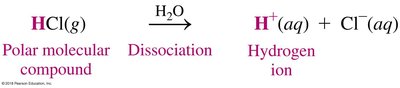
Naming Acids
For acids with simple nonmetal anions (ending in "-ide"), use the prefix hydro- and the suffix -ic acid (e.g., HCl → hydrochloric acid).
For acids with polyatomic ions:
If the ion ends in "-ate", use -ic acid (e.g., HNO3 → nitric acid).
If the ion ends in "-ite", use -ous acid (e.g., HNO2 → nitrous acid).
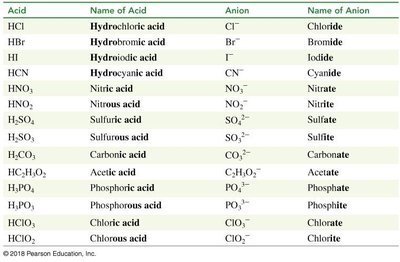
What are Bases?
Bases are ionic compounds that dissociate in water to produce hydroxide ions (OH-). They are typically formed from Group 1 and 2 metals and have characteristic properties.
Bitter taste and slippery feel (e.g., soap).
Turn red litmus paper blue and phenolphthalein indicator pink.
Common bases include NaOH, KOH, LiOH, and Ca(OH)2.
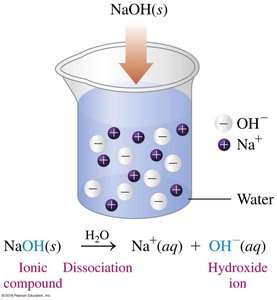
Naming Bases
Name the metal first, followed by "hydroxide" (e.g., NaOH → sodium hydroxide).
Summary Table: Properties of Acids and Bases
Characteristic | Acids | Bases |
|---|---|---|
Arrhenius Definition | Produce H+ | Produce OH- |
Electrolyte | Yes | Yes |
Taste | Sour | Bitter, chalky |
Feel | May sting | Soapy, slippery |
Litmus | Red | Blue |
Phenolphthalein | Colorless | Pink |
Neutralization | Neutralize bases | Neutralize acids |
Bronsted-Lowry Theory of Acids and Bases
The Bronsted-Lowry theory expands the definition of acids and bases beyond the Arrhenius concept. In this theory:
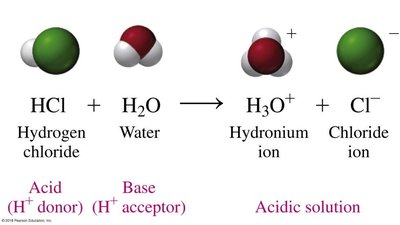
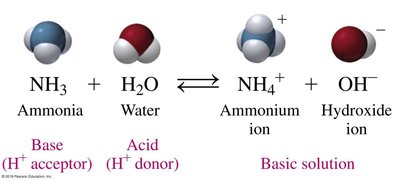
Acid: Proton (H+) donor
Base: Proton (H+) acceptor
In aqueous solutions, free hydrogen ions do not exist independently; instead, they associate with water to form hydronium ions.
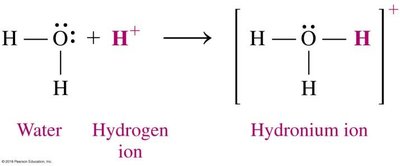
Example: Bronsted-Lowry Acid-Base Reaction
When HCl dissolves in water, HCl donates a proton to water, forming H3O+ and Cl-.
When ammonia (NH3) reacts with water, water donates a proton to ammonia, forming NH4+ and OH-.
Conjugate Acid-Base Pairs
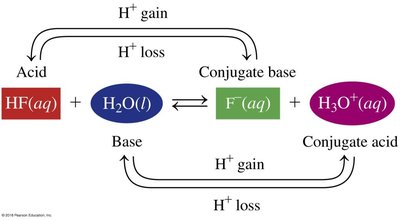
Every acid-base reaction involves two conjugate acid-base pairs. A conjugate acid-base pair consists of two species that differ by one proton (H+).
The acid loses a proton to become its conjugate base.
The base gains a proton to become its conjugate acid.
Strength of Acids and Bases
Strength of Acids
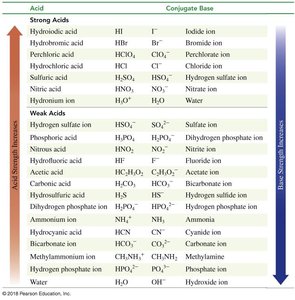
Strong acids dissociate completely in water, producing a high concentration of H3O+ ions.
Weak acids only partially dissociate, producing fewer H3O+ ions.
Example equation for strong acid dissociation:
Strength of Bases
Strong bases dissociate completely in water to produce a high concentration of OH- ions (e.g., NaOH, KOH).
Weak bases are poor acceptors of protons and produce few ions in solution.
Example equation for strong base dissociation:

Summary Table: Common Acids and Their Anions
Acid | Name of Acid | Anion | Name of Anion |
|---|---|---|---|
HCl | Hydrochloric acid | Cl- | Chloride |
HBr | Hydrobromic acid | Br- | Bromide |
HI | Hydroiodic acid | I- | Iodide |
HCN | Hydrocyanic acid | CN- | Cyanide |
HNO3 | Nitric acid | NO3- | Nitrate |
HNO2 | Nitrous acid | NO2- | Nitrite |
H2SO4 | Sulfuric acid | SO42- | Sulfate |
H2SO3 | Sulfurous acid | SO32- | Sulfite |
H2CO3 | Carbonic acid | CO32- | Carbonate |
HC2H3O2 | Acetic acid | C2H3O2- | Acetate |
H3PO4 | Phosphoric acid | PO43- | Phosphate |
HClO3 | Chloric acid | ClO3- | Chlorate |
HClO2 | Chlorous acid | ClO2- | Chlorite |
Key Equations
General acid dissociation:
General base dissociation:
Additional info: The Bronsted-Lowry theory is more general than the Arrhenius definition, as it includes reactions that do not occur in aqueous solution and bases that do not contain hydroxide ions. Understanding conjugate acid-base pairs is essential for predicting the direction of acid-base reactions and for buffer chemistry.
