 뒤로
뒤로Atoms and Elements: Structure, Properties, and Periodic Trends
스터디 가이드 - 스마트 노트
 자료에 맞춘 맞춤형 노트, 핵심 정의, 예시, 맥락을 확장해 제공합니다.
Atoms and Elements
Introduction
Atoms and elements are fundamental concepts in chemistry, forming the basis for understanding matter and its transformations. This chapter explores the structure of atoms, the organization of elements in the periodic table, and the periodic properties that govern their behavior.
Elements and Their Names
Definition and Origin
- Element: A pure substance from which all other substances are built; cannot be broken down into simpler substances. - Element names are derived from planets, mythological figures, minerals, colors, geographic locations, and famous people.
Chemical Symbols
- Chemical symbols represent element names, usually one or two letters (first letter capitalized). - Examples: C (carbon), N (nitrogen), F (fluorine), O (oxygen), Co (cobalt), Ca (calcium), Al (aluminum), Mg (magnesium). - Some symbols are derived from Latin names: Ag (silver, argentum), Au (gold, aurum).
Sample Problems
- Write the correct chemical symbol for iodine: I. - Give the name for the symbol 'P': Phosphorus.
The Periodic Table
Organization and Structure
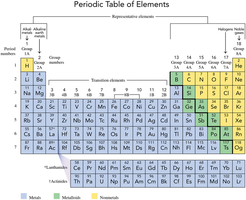
The periodic table arranges 118 elements into groups with similar properties and in order of increasing atomic mass. 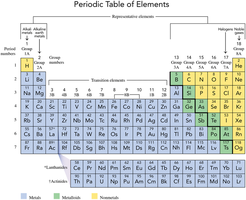 - Groups: Vertical columns containing elements with similar properties. - Periods: Horizontal rows, numbered 1–7. - Groups with special names: Alkali metals (1A), Alkaline earth metals (2A), Halogens (7A), Noble gases (8A).
Group and Period Identification
- Group numbers: 1A–8A (representative elements), 3B–12B (transition elements), or 1–18 (alternative system). - Alkali metals (1A): Li, Na, K, Rb, Cs. - Alkaline earth metals (2A): Be, Mg, Ca, Sr, Ba, Ra. - Halogens (7A): F, Cl, Br, I.
Metals, Nonmetals, and Metalloids
- Metals: Left of zigzag line; shiny, ductile, conduct heat/electricity, mostly solids, form alloys, tend to lose electrons. - Nonmetals: Right of zigzag line; dull, brittle, poor conductors, low density/melting point, tend to gain electrons. - Metalloids: Along zigzag line; properties intermediate, used as semiconductors.
Comparison Table
Type | Physical Properties | Chemical Properties |
|---|---|---|
Metal | Shiny, ductile, good conductor | Loses electrons |
Nonmetal | Dull, brittle, poor conductor | Gains electrons |
Metalloid | Intermediate, semi-conductor | Varies |
Elements Essential to Health
- 20 elements are essential for human health. - Oxygen, carbon, hydrogen, and nitrogen make up 96% of body mass. - Macrominerals (Ca, P, K, Cl, S, Na, Mg) are involved in bone formation, heart function, muscle contraction, nerve impulses, and metabolism.
The Atom
Structure and Subatomic Particles
- Atom: Smallest particle retaining element properties. - Subatomic particles: Protons (+), neutrons (0), electrons (−). - Location: Protons and neutrons in nucleus; electrons in space around nucleus.
Dalton’s Atomic Theory
- Atoms are tiny particles. - Atoms of an element are similar; different from other elements. - Atoms combine to form compounds. - Atoms rearrange in reactions; not created/destroyed.
Atomic Models
- Thomson’s Model: Electrons embedded in a positively charged cloud (“plum-pudding”). - Rutherford’s Model: Dense, positively charged nucleus; electrons surround nucleus.
Atomic Mass Unit (amu)
- 1 amu = 1/12 mass of carbon-12 atom = g. - Electrons have negligible mass.
Subatomic Particle Table
Particle | Charge | Location | Mass (amu) |
|---|---|---|---|
Proton | +1 | Nucleus | 1 |
Neutron | 0 | Nucleus | 1 |
Electron | −1 | Outside nucleus | ~0 |
Atomic Number and Mass Number
Definitions
- Atomic number (Z): Number of protons; unique for each element. - Mass number (A): Number of protons + neutrons; always a whole number. - For neutral atoms:
Sample Calculation
- Lead (Pb) with mass number 207: Protons = 82 (atomic number), Neutrons = 207 − 82 = 125, Electrons = 82.
Isotopes and Atomic Mass
Isotopes
- Atoms of same element with different mass numbers (same protons, different neutrons). - Example: Carbon-12 (6p, 6n), Carbon-13 (6p, 7n), Carbon-14 (6p, 8n).
Atomic Mass Calculation
- Atomic mass is the weighted average of all naturally occurring isotopes. - Formula:
Sample Problem
- Gallium: 60.10% (68.926 amu), 39.90% (70.925 amu).
Electron Energy Levels
Electromagnetic Radiation
- Energy moves as waves; wavelength is the distance between peaks. - High-energy radiation: short wavelength; low-energy: long wavelength.
Atomic Spectrum
- Heated elements emit light separated into distinct lines (atomic spectrum). - Each element has a unique spectrum.
Energy Levels and Sublevels
- Electrons occupy energy levels (n = 1, 2, ...), farther from nucleus = higher energy. - Sublevels: s, p, d, f. - Number of sublevels = principal quantum number n.
Orbitals
- s orbital: Spherical, max 2 electrons. - p orbital: Dumbbell-shaped, three per energy level (n ≥ 2), max 6 electrons. - d orbital: Five per energy level (n ≥ 3), max 10 electrons. - f orbital: Seven per energy level (n ≥ 4), max 14 electrons.
Electron Spin and Capacity
- Pauli exclusion principle: max 2 electrons per orbital, must have opposite spins.
Sublevel Electron Capacity Table
Sublevel | Number of Orbitals | Max Electrons |
|---|---|---|
s | 1 | 2 |
p | 3 | 6 |
d | 5 | 10 |
f | 7 | 14 |
Electron Configurations
Orbital Diagrams and Notation
- Orbital diagrams use boxes/arrows to show electron arrangement. - Electron configuration notation indicates placement of electrons in energy levels/sublevels. - Abbreviated form uses noble gas to represent filled shells.
Blocks on the Periodic Table
- s block: Groups 1A, 2A. - p block: Groups 3A–8A. - d block: Transition elements. - f block: Inner transition elements.
Sample Electron Configurations
- Carbon: - Sodium:
Orbital Diagram Example
Trends in Periodic Properties
Valence Electrons
- Valence electrons are in the outermost energy level; determine chemical properties. - Group number = number of valence electrons for representative elements.
Lewis Symbols
- Lewis symbols represent valence electrons as dots around element symbol. 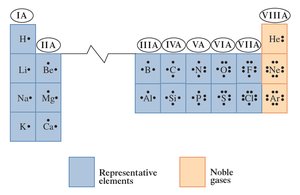
Periodic Trends
- Atomic size: Increases down a group, decreases across a period. - Ionization energy: Decreases down a group, increases across a period. - Metallic character: Increases down a group, decreases across a period.
Summary Table of Periodic Trends
Trend | Down a Group | Across a Period |
|---|---|---|
Atomic Size | Increases | Decreases |
Ionization Energy | Decreases | Increases |
Metallic Character | Increases | Decreases |
Sample Problems
- Which is the largest atom: C, N, or F? Answer: C. - Which has the highest ionization energy? Answer: F. - Which belongs to Group 5A (15)? Answer: N.
Conclusion
Understanding atoms and elements, their structure, and periodic properties is essential for predicting chemical behavior and reactions. The periodic table is a powerful tool for organizing and interpreting these properties, guiding the study of chemistry and its applications in health, industry, and the environment.
