 뒤로
뒤로Calculating Solution Concentration in GOB Chemistry
스터디 가이드 - 스마트 노트
 자료에 맞춘 맞춤형 노트, 핵심 정의, 예시, 맥락을 확장해 제공합니다.
Calculating Solution Concentration
Introduction to Solution Concentrations
Solution concentration is a fundamental concept in chemistry, describing the amount of solute present in a given quantity of solution. Understanding how to calculate and express concentration is essential for preparing solutions and performing quantitative chemical analyses. Concentration can be expressed in various units depending on the context and the physical state of the solute and solvent.
Solute: The substance dissolved in a solution.
Solvent: The substance in which the solute is dissolved, typically present in greater amount.
Solution: A homogeneous mixture of solute and solvent.
Common units for expressing concentration include mass percent (m/m), volume percent (v/v), mass/volume percent (m/v), and molarity (M).

Types of Solution Concentration
Mass Percent (m/m) Concentration
Mass percent expresses the mass of solute in 100 grams of solution. It is commonly used for solid solutes dissolved in liquids. The formula for mass percent is:
Key Point: Both solute and solution masses must be in grams.
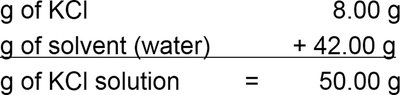
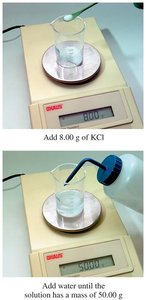
Example: Dissolving 8.00 g of KCl in 42.00 g of water yields a 50.00 g KCl solution. The mass percent is:
Volume Percent (v/v) Concentration
Volume percent is used for solutions where both solute and solvent are liquids or gases. It expresses the volume of solute in 100 mL of solution. The formula is:
Key Point: Both solute and solution volumes must be in the same units (mL or L).
Example: 12 mL of ethanol in 100 mL of solution is a 12% (v/v) ethanol solution.
Mass/Volume Percent (m/v) Concentration
Mass/volume percent is commonly used in biological and medical contexts. It expresses the mass of solute in 100 mL of solution. The formula is:
Key Point: Mass is in grams, volume is in milliliters.
Example: 5 g of glucose in 100 mL of solution is a 5% (m/v) glucose solution.
Molarity (M) Concentration
Molarity is the number of moles of solute per liter of solution. It is the most common unit for expressing concentration in chemical reactions and laboratory work. The formula is:
Key Point: Moles of solute are calculated using the molar mass of the compound.
Example: To find the molarity of a solution containing 6.00 g of NaOH in 0.500 L of solution:
1. Calculate moles of NaOH:
2. Calculate molarity:
Using Concentration as a Conversion Factor
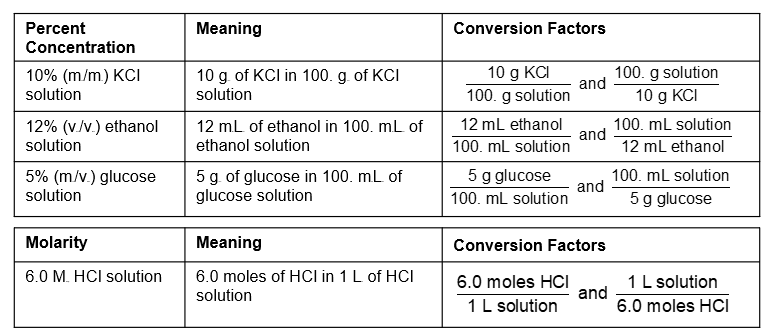
Concentration values can be used as conversion factors to calculate the amount of solute or solution required for a specific preparation. For example, a 10% (m/m) KCl solution means 10 g of KCl per 100 g of solution, which can be used to convert between grams of solute and grams of solution.
Summary Table: Concentration Units and Conversion Factors
Percent Concentration | Meaning | Conversion Factors |
|---|---|---|
10% (m/m) KCl solution | 10 g of KCl in 100 g of KCl solution | 10 g KCl / 100 g solution and 100 g solution / 10 g KCl |
12% (v/v) ethanol solution | 12 mL of ethanol in 100 mL of ethanol solution | 12 mL ethanol / 100 mL solution and 100 mL solution / 12 mL ethanol |
5% (m/v) glucose solution | 5 g of glucose in 100 mL of glucose solution | 5 g glucose / 100 mL solution and 100 mL solution / 5 g glucose |
Molarity | Meaning | Conversion Factors |
|---|---|---|
6.0 M HCl solution | 6.0 moles of HCl in 1 L of HCl solution | 6.0 moles HCl / 1 L solution and 1 L solution / 6.0 moles HCl |
Practice Problems
Calculate the mass percent (m/m) of a solution prepared by mixing 15.0 g of Na2CO3 and 235 g of H2O.
Write two conversion factors for each of the following:
8.50% (m/m) NaOH
5.75% (v/v) ethanol
4.8% (m/v) HCl
What is the molarity of 0.225 L of KNO3 solution containing 34.8 g of KNO3?
How many grams of NaOH are needed to prepare 75.0 g of 14.0% (m/m) NaOH solution?
How many mL of 5.75% (v/v) ethanol solution can be prepared from 2.25 mL of ethanol?
Additional info: These calculations are essential for laboratory preparations and quantitative chemical analysis. Mastery of these concepts is foundational for further studies in chemistry, biology, and health sciences.
