 뒤로
뒤로Chapter 1: Chemistry Basics—Matter and Measurement (GOB Chemistry Study Notes)
스터디 가이드 - 스마트 노트
 자료에 맞춘 맞춤형 노트, 핵심 정의, 예시, 맥락을 확장해 제공합니다.
Chemistry Basics—Matter and Measurement
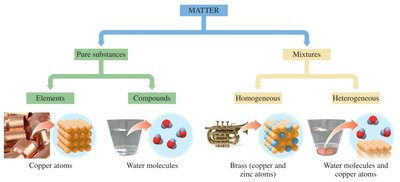
1.1 Classifying Matter: Pure Substance or Mixture
Chemistry begins with understanding matter, which is anything that occupies space and has mass. Matter can be classified based on its composition and uniformity.
Pure Substance: Composed of only one type of particle and can be represented by a single chemical formula or symbol. Subdivided into:
Element: Simplest form of matter, made of one type of atom (e.g., Calcium, Hydrogen, Carbon).
Compound: Pure substance formed from two or more elements chemically combined in fixed ratios (e.g., Water (H2O), Rust (Fe2O3)).
Mixture: Combination of two or more substances that can be separated by physical means. Subdivided into:
Homogeneous Mixture: Uniform composition throughout (e.g., Air, Coffee).
Heterogeneous Mixture: Non-uniform composition, visibly different parts (e.g., Vegetable soup, Chocolate chip cookie).
Examples:
Gold – Pure substance (element)
Coffee – Mixture (homogeneous)
Table salt – Pure substance (compound)
Vegetable soup – Mixture (heterogeneous)
1.2 Elements, Compounds, and the Periodic Table
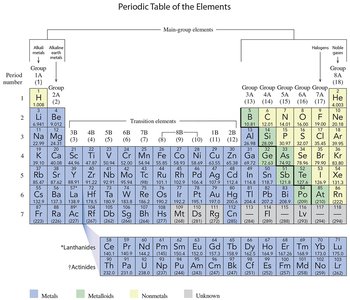
The periodic table organizes all known elements based on their properties and atomic structure. It is a foundational tool in chemistry for understanding elements and their relationships.
Element Symbols: Each element is represented by a one- or two-letter symbol, often derived from its English or Latin name (e.g., Na for sodium, Au for gold).
Groups (Columns): Vertical columns with similar chemical properties. Numbered 1–18 (IUPAC system). Main-group elements are labeled with 'A', transition elements with 'B'.
Periods (Rows): Horizontal rows numbered 1–7. Elements in the same period have the same number of electron shells.
Metals, Nonmetals, Metalloids: The staircase line separates metals (left), nonmetals (right), and metalloids (bordering the line, except Al).
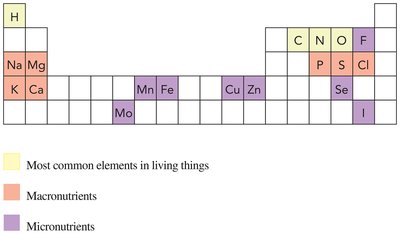
Biologically Important Elements:
Macronutrients: Needed in >100 mg/day (e.g., Na, Mg, K, Ca, Cl).
Micronutrients: Needed in <100 mg/day (e.g., I, F, Fe, Zn).
Most abundant in living things: C, H, O, N.
Compounds: Pure substances with two or more elements in fixed ratios, represented by chemical formulas (e.g., H2O, NaCl).
1.3 How Matter Changes
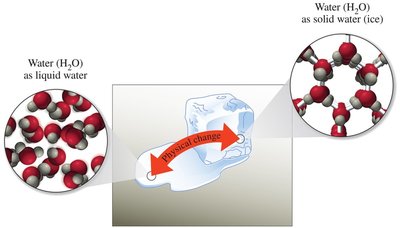
Matter can undergo physical or chemical changes. Understanding these changes is essential for describing chemical reactions and processes.
Physical Change: Alters the state or appearance of matter without changing its chemical identity (e.g., melting ice, dissolving sugar).
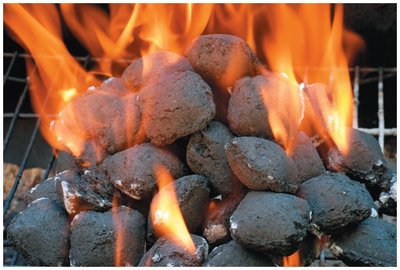
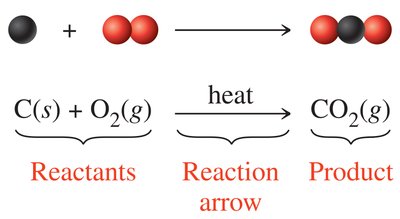
Chemical Change (Reaction): Alters the chemical identity of a substance, forming new substances (e.g., burning charcoal, rusting iron).
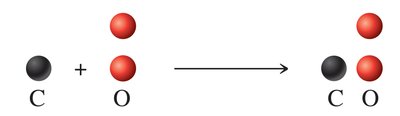
Chemical Equations: Represent chemical reactions using symbols and formulas. The reactants are on the left, products on the right, separated by a reaction arrow.
Balancing Chemical Equations: The number of atoms of each element must be equal on both sides, following the law of conservation of mass. Use coefficients to balance equations.
Steps to Balance Equations:
Examine the equation for balance.
Balance one element at a time using coefficients.
Check that all elements are balanced with the smallest set of coefficients.
Example: Balancing CH4 + O2 → CO2 + H2O yields CH4 + 2 O2 → CO2 + 2 H2O.
1.4 Math Counts
Mathematical concepts are central to chemistry, including measurement systems, unit conversions, significant figures, and scientific notation.
SI Units: Standard units include kilogram (kg) for mass, liter (L) for volume, and meter (m) for length. Prefixes (e.g., milli-, centi-, kilo-) indicate powers of ten.
Unit Conversions: Use conversion factors to change from one unit to another (e.g., 1 mg = 1 × 10⁻³ g).
Dimensional Analysis: A systematic approach to unit conversion using conversion factors.
Significant Figures: Digits in a measurement that are known with certainty plus one estimated digit. Rules determine which digits are significant, especially zeros.
Calculations and Rounding: The result of a calculation cannot be more precise than the least precise measurement. Addition/subtraction: match decimal places; multiplication/division: match significant digits.
Scientific Notation: Expresses numbers as C × 10n, where 1 ≤ C < 10 and n is an integer. Only significant figures are shown in the coefficient.
Percentages: Percent (%) means per hundred. Calculated as (part/whole) × 100.
1.5 Matter: The “Stuff” of Chemistry
Understanding the properties of matter involves measuring mass, volume, density, temperature, and recognizing the states of matter.
Mass: Amount of material in an object, measured in grams (g).
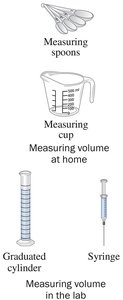
Volume: Space occupied by matter, measured in liters (L) or milliliters (mL). 1 mL = 1 cm3 (cc).
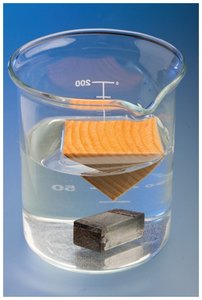
Density (d): Ratio of mass to volume, , typically in g/mL.
Specific Gravity: Ratio of the density of a sample to the density of water (unitless).
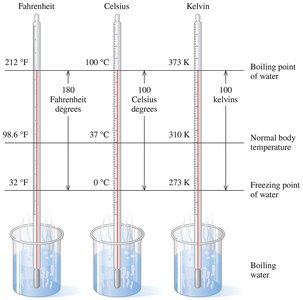
Temperature: Measured in Celsius (°C), Fahrenheit (°F), or Kelvin (K). Conversion formulas:
States of Matter: Solid (definite shape/volume), liquid (definite volume, shape of container), gas (fills container, no definite shape/volume).
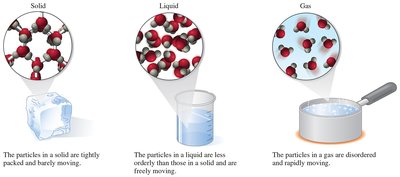
Property of a Substance | Solid | Liquid | Gas |
|---|---|---|---|
Shape | Definite shape | Adopts shape of container | Adopts shape of container |
Volume | Definite volume | Definite volume | Fills volume of container |
Kinetic energy | Lowest | Intermediate | Highest |
Positioning of particles | Closely packed, fixed | Loosely packed, random | Far apart, random |
Attraction between particles | Very strong | Strong | Practically none |
1.6 Measuring Matter
Accurate and precise measurements are essential in chemistry and health sciences. Understanding units and conversions is critical for calculations and dosing.
Accuracy: How close a measurement is to the true value.
Precision: How close repeated measurements are to each other.
SI and U.S. Customary Units: Health professionals must convert between systems (e.g., 1 inch = 2.54 cm, 1 lb = 0.454 kg).
Dosage Calculations: Use dimensional analysis to determine correct medication dosages based on body weight and unit conversions.
Drop Units (gtt/mL): Used in IV medication delivery; drip rates are calculated using drop factors and time conversions.
Percents in Health: Used for active ingredient concentration, dosing adjustments, and nutrition labeling.
Additional info: These notes cover all major topics from Chapter 1 of a GOB Chemistry course, including classification of matter, the periodic table, chemical and physical changes, measurement systems, significant figures, scientific notation, density, specific gravity, temperature, states of matter, and health-related calculations.
