 뒤로
뒤로Chemical Quantities and Reactions – GOB Chemistry Study Notes
스터디 가이드 - 스마트 노트
 자료에 맞춘 맞춤형 노트, 핵심 정의, 예시, 맥락을 확장해 제공합니다.
Ch.7 Chemical Quantities and Reactions
Chemical Reactions: Chemical Change
Chemical reactions are processes in which substances (reactants) are transformed into new substances (products) through the breaking and forming of chemical bonds. These changes are classified as chemical changes, distinct from physical changes, and are often accompanied by observable evidence.
Chemical Equation: A symbolic representation using chemical formulas and symbols to describe a chemical reaction.
Evidence of Chemical Reaction: Observable changes such as color change, formation of a precipitate, evolution of a gas, or temperature change.

Example: When sodium carbonate decomposes at high temperature, it forms sodium oxide and carbon dioxide gas:
Symbols in Chemical Equations
(s): Solid
(l): Liquid
(g): Gas
(aq): Aqueous (dissolved in water)
Δ: Heat is applied
→: Yields or produces
Balancing Chemical Equations
Principles and Steps
Balancing chemical equations ensures the law of conservation of mass is obeyed, meaning the number and type of atoms are the same on both sides of the equation.
Coefficients are used to balance the number of atoms.
Polyatomic ions that appear unchanged on both sides can be balanced as units.
If fractional coefficients are used, multiply the entire equation to obtain whole numbers.
Example: Balance the equation for the reaction of sodium phosphate and calcium nitrate:
Types of Chemical Reactions
Classification and Examples
Chemical reactions are classified based on the rearrangement of atoms and the types of products formed:
Combination (Synthesis): Multiple reactants form one product.
Decomposition: One reactant splits into two or more products.
Combustion: A hydrocarbon reacts with O2 to produce CO2 and H2O.
Single Displacement: One element replaces another in a compound.
Double Displacement: Ions in two compounds exchange places.
Redox Reactions: Involve the transfer of electrons between reactants.
Example: Combustion of ibuprofen (C13H18O2):
Oxidation Numbers and Redox Reactions
Oxidation Number Rules
Oxidation numbers are assigned to elements in compounds to track electron transfer in redox reactions. Specific rules are used for different groups and elements.
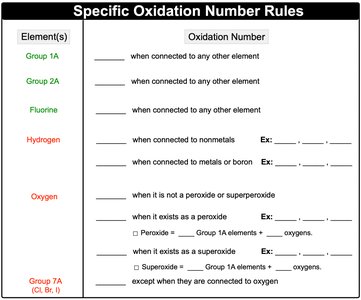
Group 1A: +1
Group 2A: +2
Fluorine: -1
Hydrogen: +1 (with nonmetals), -1 (with metals/boron)
Oxygen: -2 (except in peroxides: -1, or with fluorine: +2)
Group 7A: -1 (except with oxygen or other halogens)
For non-listed elements, assign an unknown, use known oxidation numbers, distribute subscripts, and set the sum equal to the compound's charge.
Redox Reactions
Redox (oxidation-reduction) reactions involve the transfer of electrons. The substance that loses electrons is oxidized (reducing agent), and the one that gains electrons is reduced (oxidizing agent).
LEO the lion says GER: Lose Electrons = Oxidation, Gain Electrons = Reduction.
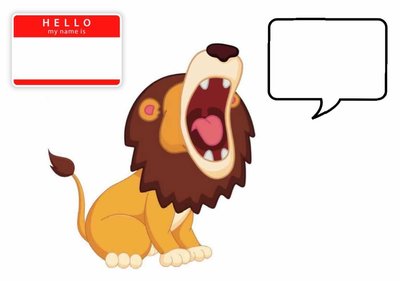
Example: In the reaction , lithium is oxidized and zinc is reduced.
Molar Mass and the Mole Concept
Calculating Molar Mass
Molar mass is the mass (in grams) of one mole of a substance, calculated by summing the atomic masses of all atoms in a formula.
Use the periodic table for atomic masses.
Multiply the number of each atom by its atomic mass and sum the results.
Example: Molar mass of :
The Mole and Avogadro's Number
The mole is a counting unit in chemistry, defined as the amount of substance containing particles (Avogadro's number).
1 mole of any substance contains particles (atoms, molecules, ions, or formula units).
1 mole of a substance has a mass equal to its molar mass in grams.
Example: 2.34 moles of Cl2 weighs .
Stoichiometry
Stoichiometric Calculations
Stoichiometry involves using balanced chemical equations to calculate the relationships between reactants and products in a chemical reaction.
Convert given quantities to moles.
Use mole ratios from the balanced equation to find moles of the desired substance.
Convert moles to the required units (grams, molecules, etc.).
Example: How many grams of H2O are produced from 12.3 g H2?
Endothermic and Exothermic Reactions
Energy Changes in Reactions
Chemical reactions can absorb or release energy, usually in the form of heat.
Endothermic Reactions: Absorb heat from the surroundings; products have higher energy than reactants.
Exothermic Reactions: Release heat to the surroundings; products have lower energy than reactants.
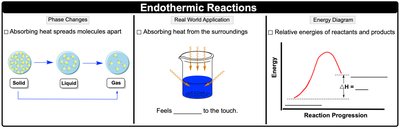
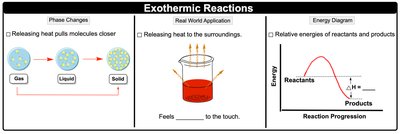
Example: Water boiling is endothermic; CO2 burning is exothermic.
Reaction Rates and Energy Diagrams
Factors Affecting Reaction Rate
The rate of a chemical reaction depends on several factors:
Concentration: Higher concentration increases collision frequency.
Surface Area: Greater surface area increases reaction rate.
Temperature: Higher temperature increases kinetic energy and collision frequency.
Catalyst: Lowers activation energy, increasing reaction rate.
Energy Diagrams
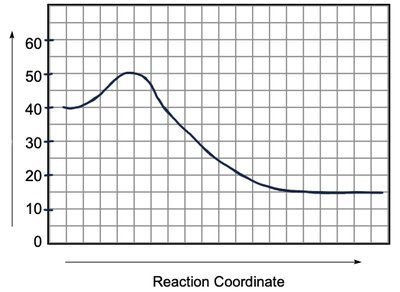
Energy diagrams plot the energy changes during a reaction, showing reactants, products, transition state, and activation energy.
Activation Energy (Ea): The minimum energy required for a reaction to occur.
Overall Energy Change (ΔH or ΔG): Difference in energy between reactants and products.
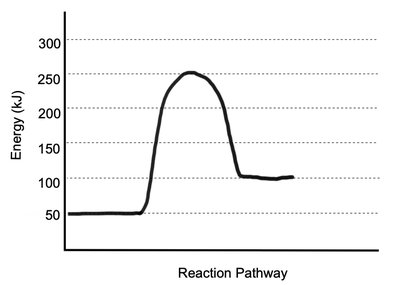
Example: The reaction with the lowest activation energy proceeds the fastest.
Comparing Reaction Speeds
Reactions with lower activation energies occur more rapidly than those with higher activation energies.
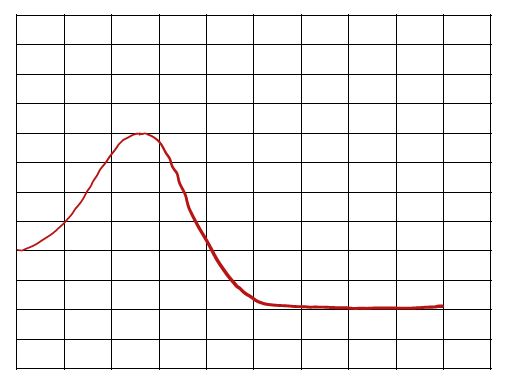
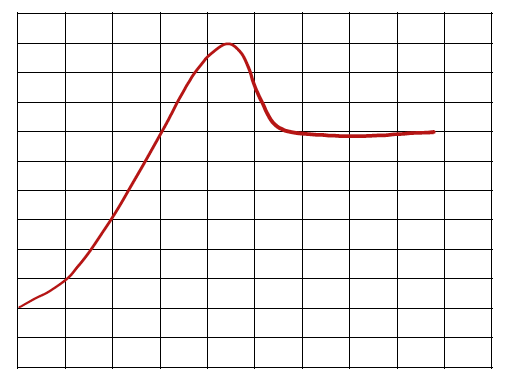
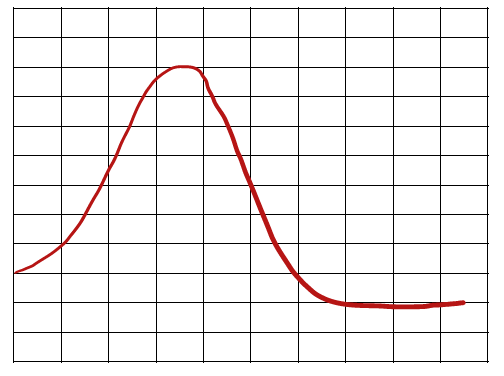
Additional info: The notes above include all major concepts from Ch.7 Chemical Quantities and Reactions, including balancing equations, reaction types, redox, stoichiometry, energy changes, and reaction rates, with relevant images and academic context for GOB Chemistry students.
