 뒤로
뒤로Gases: Properties, Laws, and Applications
스터디 가이드 - 스마트 노트
 자료에 맞춘 맞춤형 노트, 핵심 정의, 예시, 맥락을 확장해 제공합니다.
Gases
Introduction to Gases
Gases are one of the fundamental states of matter, characterized by their ability to expand and fill any container. Unlike solids and liquids, gases are composed of particles that are far apart and move freely, resulting in unique physical properties.
Composed of non-metallic elements
Simple molecular formulas
Low molar masses
Compressible
Form homogeneous mixtures when two or more gases are combined
Pressure
Pressure is defined as the force exerted per unit area by gas particles as they collide with the surfaces of their container. Atmospheric pressure is the force exerted by the atmosphere on a given surface area.
Units of Pressure: 1 atm = 760 mm Hg = 760 torr = 1.01 × 10⁵ Pa = 101.325 kPa = 1.01325 bar
Pressure conversions are essential for solving gas law problems.
Gas Laws
The physical state of a gas is described by four variables: pressure (P), volume (V), temperature (T), and amount (n, in moles). Three fundamental gas laws relate these variables under different conditions:
Boyle’s Law: At constant temperature, the volume of a fixed amount of gas is inversely proportional to its pressure.
Charles’s Law: At constant pressure, the volume of a fixed amount of gas is directly proportional to its absolute temperature (in Kelvin).
\( \frac{V_1}{T_1} = \frac{V_2}{T_2} \)
Avogadro’s Law: At constant temperature and pressure, the volume of a gas is directly proportional to the number of moles of gas present.
\( \frac{V_1}{n_1} = \frac{V_2}{n_2} \)
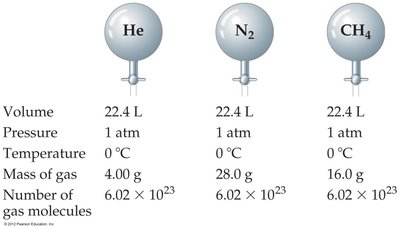
Standard Temperature and Pressure (STP)
STP is a reference point for gas measurements, defined as a temperature of 0°C (273.15 K) and a pressure of 1 atm. At STP, one mole of any ideal gas occupies 22.4 L.
1 mol gas = 22.4 L at STP
The Ideal Gas Law
The three gas laws can be combined into the Ideal Gas Law, which describes the relationship between pressure, volume, temperature, and amount of gas for an ideal gas:
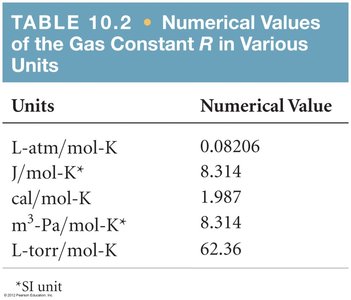
R is the universal gas constant. Its value depends on the units used for pressure, volume, and temperature.
Units | Numerical Value |
|---|---|
L·atm/mol·K | 0.08206 |
J/mol·K | 8.314 |
cal/mol·K | 1.987 |
m3·Pa/mol·K | 8.314 |
L·torr/mol·K | 62.36 |
Applications of the Ideal Gas Law
The ideal gas law can be rearranged to solve for any variable, and is used to predict the behavior of gases under changing conditions. Some useful forms include:
(when n and T are constant)
(when n is constant)
(when n and P are constant)
(when n and V are constant)
Example Problems
Decomposition of Calcium Carbonate: Calculate moles of CO2 collected in a flask using the ideal gas law.
Gas Pressure in an Aerosol Can: Predict the pressure change when temperature increases, assuming constant volume.
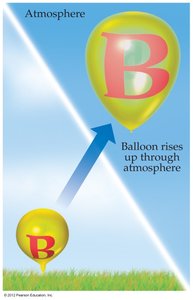
Balloon Ascent: Calculate the final volume of a balloon as it rises and both pressure and temperature change.

Summary Table: Gas Laws and Their Relationships
Law | Variables Held Constant | Relationship | Equation |
|---|---|---|---|
Boyle's Law | n, T | V ∝ 1/P | |
Charles's Law | n, P | V ∝ T | |
Avogadro's Law | P, T | V ∝ n | |
Ideal Gas Law | — | PV = nRT |
Example: If a balloon with a volume of 6.0 L at 1.0 atm and 22°C rises to a region where the pressure is 0.45 atm and the temperature is -21°C, use the combined gas law to find the new volume.
Additional info: The images included reinforce the concepts of gas behavior, the effect of atmospheric changes on gas volume, and the relationships described by the gas laws.
