 뒤로
뒤로Matter and Its States: Classification and Changes
스터디 가이드 - 스마트 노트
 자료에 맞춘 맞춤형 노트, 핵심 정의, 예시, 맥락을 확장해 제공합니다.
States of Matter
Overview of States of Matter
Matter can exist in three primary states: solid, liquid, and gas. The state of a substance depends on the temperature and the strength of the attractive forces between its particles compared to their kinetic energy.
Solid: Definite shape and volume; particles are closely packed and vibrate in place.
Liquid: Definite volume but takes the shape of its container; particles are less tightly packed and can move past each other.
Gas: No definite shape or volume; particles are far apart and move freely.
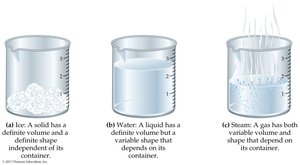
Example: Water can exist as ice (solid), liquid water, or steam (gas) depending on temperature.
Changes of State
Substances can change from one state to another through physical processes such as melting, freezing, and boiling. These changes involve energy transfer and changes in particle arrangement.
Melting: Solid to liquid. Heat is absorbed, increasing kinetic energy and disorder. (endothermic), (increase in disorder).
Freezing: Liquid to solid. Heat is released, decreasing kinetic energy and disorder. (exothermic), (decrease in disorder).
Example: Formaldehyde has a melting point of –92 °C and a boiling point of –19.5 °C. At room temperature (25 °C), it is a gas because room temperature is above its boiling point.
Classification of Matter
Pure Substances vs. Mixtures
Matter can be classified as either a pure substance or a mixture. Pure substances have a fixed composition, while mixtures contain two or more substances physically combined.
Pure Substance: Only one kind of matter. Can be an element (cannot be broken down further) or a compound (can be broken down by chemical change).
Mixture: Contains more than one kind of matter. Can be homogeneous (uniform composition) or heterogeneous (non-uniform composition).
Example:
Vanilla ice cream: Homogeneous mixture (cream, sugar, vanilla flavoring, uniform throughout).
Sugar: Pure substance (compound, as it can be chemically changed).
Additional info: Homogeneous mixtures are also called solutions; heterogeneous mixtures include suspensions and colloids.
