 뒤로
뒤로Mole and Mass Calculations in Chemical Reactions
스터디 가이드 - 스마트 노트
 자료에 맞춘 맞춤형 노트, 핵심 정의, 예시, 맥락을 확장해 제공합니다.
Mole and Mass Calculations in Chemical Reactions
Law of Conservation of Mass
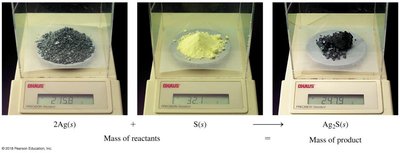
The Law of Conservation of Mass states that in a chemical reaction, the total mass of the reactants is equal to the total mass of the products. This means that matter is neither created nor destroyed during a chemical reaction; it simply changes form. This principle is fundamental to all chemical calculations and ensures that equations are balanced in terms of both mass and atoms.
Definition: The mass of substances present before a chemical reaction must equal the mass of substances after the reaction.
Application: Used to verify chemical equations and in stoichiometric calculations.
Example: When 2 moles of silver (Ag) react with 1 mole of sulfur (S), the combined mass of Ag and S equals the mass of the product, silver sulfide (Ag2S).
Mole-Mole Relationships in Balanced Chemical Equations
Balanced chemical equations provide the mole ratios (also called mole-mole factors) between reactants and products. These ratios are derived from the coefficients in the equation and are essential for converting between amounts of substances in a reaction.
Definition: A mole-mole factor is a conversion factor derived from the coefficients of a balanced chemical equation, relating the moles of one substance to the moles of another.
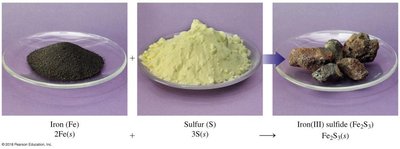
Example: For the reaction: 2Fe(s) + 3S(s) → Fe2S3(s), the following mole-mole factors can be written:
2 moles Fe / 3 moles S (and vice versa)
1 mole Fe2S3 / 2 moles Fe (and vice versa)
1 mole Fe2S3 / 3 moles S (and vice versa)
Steps for Calculating Moles in Chemical Reactions
To solve stoichiometric problems involving moles, follow these steps:
State the given and needed quantities.
Write a plan to convert the given quantity to the needed quantity (in moles).
Use coefficients to write mole-mole factors.
Set up the calculation to solve for the needed quantity.
Example: For the reaction 3H2(g) + N2(g) → 2NH3(g):
Mole-mole factor for H2 and N2: 3 moles H2 / 1 mole N2
Mole-mole factor for NH3 and H2: 2 moles NH3 / 3 moles H2
Mass Calculations in Chemical Reactions
When given the mass of one substance in a reaction, you can calculate the mass of another substance by following a systematic approach. This involves converting mass to moles, using the mole-mole factor, and then converting back to mass.
Step 1: Convert the given mass to moles using the molar mass.
Step 2: Use the mole-mole factor from the balanced equation to find moles of the desired substance.
Step 3: Convert the moles of the desired substance to mass using its molar mass.

Example: How many grams of O2 are needed to produce 45.8 g of Fe2O3 in the reaction 4Fe(s) + 3O2(g) → 2Fe2O3(s)?
Linking Moles, Mass, and Molar Mass
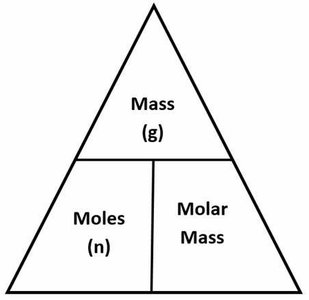
The relationship between mass, moles, and molar mass is fundamental in chemistry. The following equation is used to interconvert these quantities:
Formula:
To find mass:
To find molar mass:
Example: The reaction 2H2(g) + O2(g) → 2H2O(g) produces 13.1 g of water. To find the grams of O2 reacted, use the above relationships and the balanced equation.
Summary Table: Steps for Mass-Mass Calculations
Step | Description |
|---|---|
1 | Convert given mass to moles (using molar mass) |
2 | Use mole-mole factor from balanced equation |
3 | Convert moles of desired substance to mass (using molar mass) |
Additional info: These concepts are foundational for all stoichiometric calculations in general, organic, and biological chemistry, and are essential for quantitative problem-solving in laboratory and clinical settings.
