 뒤로
뒤로Organic Acids and Carbohydrates: Structures and Nomenclature
스터디 가이드 - 스마트 노트
 자료에 맞춘 맞춤형 노트, 핵심 정의, 예시, 맥락을 확장해 제공합니다.
Organic Acids
Introduction to Organic Acids
Organic acids are a class of organic compounds characterized by the presence of a carboxyl group (-COOH). They are commonly found in biological systems and play important roles in metabolism and chemical synthesis. The simplest organic acids are known as carboxylic acids.
Common and IUPAC Names of Selected Organic Acids
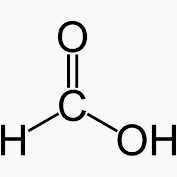
Methanoic acid (IUPAC name), also known as formic acid (common name), is the simplest carboxylic acid with the formula HCOOH.
Ethanoic acid (IUPAC name), commonly called acetic acid, has the formula CH3COOH and is the main component of vinegar.
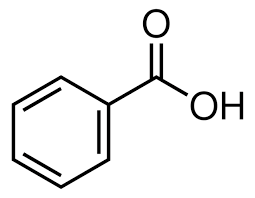
Benzoic acid is an aromatic carboxylic acid with the formula C6H5COOH, used as a food preservative and in organic synthesis.
General formula for carboxylic acids:
where R is a hydrocarbon group.
Example: The structure below shows benzoic acid, an aromatic carboxylic acid.
Example: The structure below shows formic acid (methanoic acid), the simplest carboxylic acid.
Carbohydrates
Monosaccharides: Structure and Projections
Monosaccharides are the simplest carbohydrates and serve as the building blocks for more complex sugars. They are classified based on the number of carbon atoms and the functional group present (aldehyde or ketone).
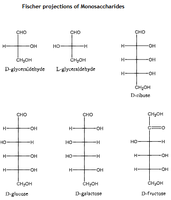
Fischer projections are a two-dimensional representation of the three-dimensional structure of monosaccharides, showing the configuration of each chiral center.
Common monosaccharides include D-glucose, D-galactose, and D-fructose.
Example: The image below shows Fischer projections of several important monosaccharides.
Haworth Projections of Monosaccharides
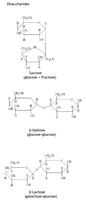
Haworth projections are used to represent the cyclic (ring) forms of monosaccharides, which are the predominant forms in aqueous solutions. These projections help visualize the stereochemistry of the ring structure.
Pyranose rings are six-membered rings, as seen in glucose and galactose.
Furanose rings are five-membered rings, as seen in fructose.
Example: The image below shows Haworth projections of common monosaccharides in their cyclic forms.
Disaccharides: Structure and Examples
Disaccharides are carbohydrates composed of two monosaccharide units joined by a glycosidic bond. Common examples include sucrose, maltose, and lactose.
Sucrose is composed of glucose and fructose.
Maltose consists of two glucose units.
Lactose is made of glucose and galactose.
General formula for disaccharides:
Example: The image below shows the structures of sucrose, maltose, and lactose, highlighting the glycosidic bonds between monosaccharide units.
Summary Table: Selected Organic Acids
IUPAC Name | Common Name | Structure |
|---|---|---|
Methanoic acid | Formic acid | HCOOH |
Ethanoic acid | Acetic acid | CH3COOH |
Benzoic acid | Benzoic acid | C6H5COOH |
Additional info: The notes above expand on the provided images and text by including definitions, examples, and context for GOB Chemistry students, as well as a summary table for clarity.
