 뒤로
뒤로Properties and Laws of Gases: GOB Chemistry Study Notes
스터디 가이드 - 스마트 노트
 자료에 맞춘 맞춤형 노트, 핵심 정의, 예시, 맥락을 확장해 제공합니다.
Properties of Gases
Key Properties of Gases
Gases are characterized by several measurable properties that describe their physical behavior. Understanding these properties is essential for predicting and explaining gas behavior in chemical and biological systems.
Temperature (T): A measure of the average kinetic energy of gas particles. Increasing temperature increases the kinetic energy of the particles.
Pressure (P): The force exerted by gas particles colliding with the walls of their container. Common units include atmospheres (atm), millimeters of mercury (mmHg), and pounds per square inch (psi).
Volume (V): The space occupied by a gas, typically measured in liters (L) or milliliters (mL).
Amount (n): The quantity of gas present, measured in moles (mol) or grams (g).
Example: When helium is added to a balloon, the mass (amount) of helium increases, which is a direct measure of the amount of gas present.
Gas Laws
Boyle’s Law: Pressure–Volume Relationship
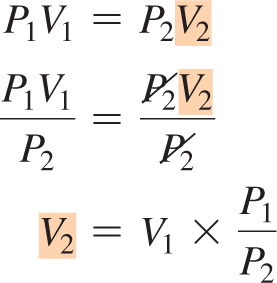
Boyle’s Law describes the inverse relationship between the pressure and volume of a gas when temperature and amount of gas are held constant. As pressure decreases, volume increases, and vice versa.
Mathematical Expression:
Application: Used to calculate the change in volume or pressure when the other changes, provided temperature and amount are constant.
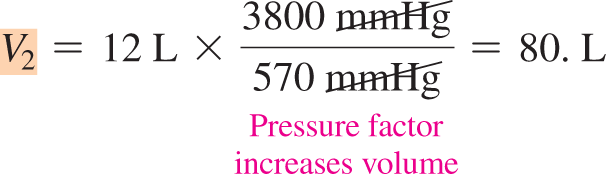
Example: A 12-L tank of oxygen at 3800 mmHg will expand to a larger volume if the pressure is reduced to 570 mmHg, as shown below.


Charles’s Law: Temperature–Volume Relationship
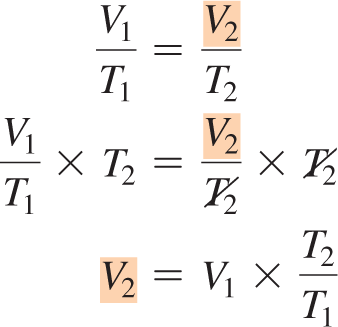
Charles’s Law states that the volume of a gas is directly proportional to its absolute temperature (in Kelvin) when pressure and amount of gas are constant. As temperature increases, volume increases.
Mathematical Expression:
Application: Used to determine the change in volume or temperature when the other changes, with pressure and amount constant.
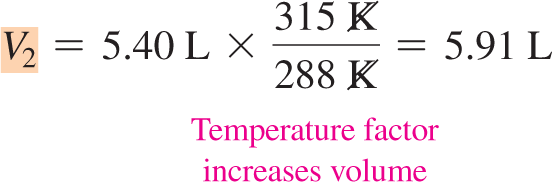
Example: Helium gas at 5.40 L and 15 °C expands to a larger volume when heated to 42 °C, as shown below.

Gay-Lussac’s Law: Temperature–Pressure Relationship
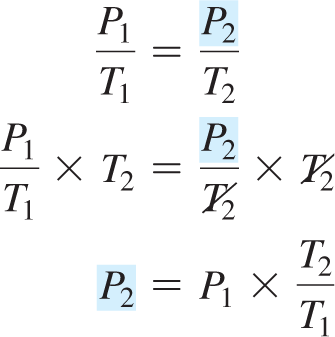
Gay-Lussac’s Law describes the direct relationship between the pressure and absolute temperature of a gas when volume and amount are constant. As temperature increases, pressure increases.
Mathematical Expression:
Application: Used to predict the change in pressure or temperature when the other changes, with volume and amount constant.
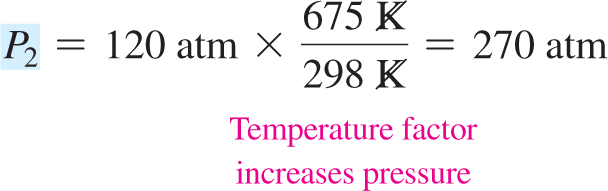
Example: An oxygen tank at 120 atm and 25 °C will reach a much higher pressure if heated to 402 °C, potentially causing the tank to rupture.

The Combined Gas Law
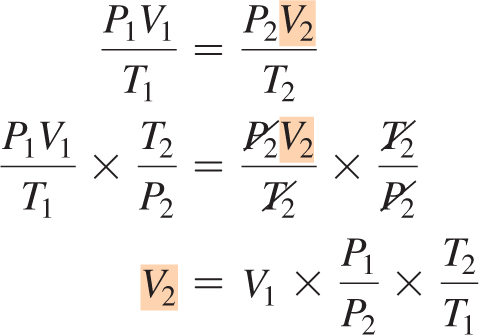
The Combined Gas Law relates pressure, volume, and temperature for a fixed amount of gas. It is useful when more than one variable changes.
Mathematical Expression:
Application: Used to solve problems where pressure, volume, and temperature all change, but the amount of gas remains constant.
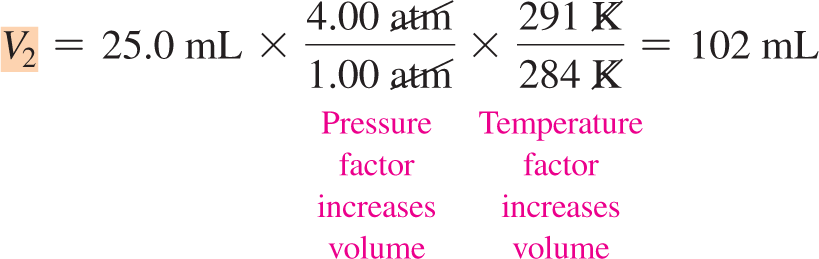
Example: A 25.0-mL bubble released at 4.00 atm and 11 °C will expand to a larger volume at 1.00 atm and 18 °C.


Avogadro’s Law: Volume–Amount Relationship
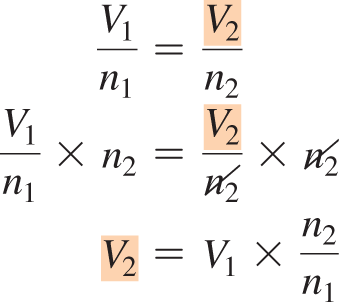
Avogadro’s Law states that the volume of a gas is directly proportional to the number of moles of gas when pressure and temperature are constant. Increasing the amount of gas increases the volume.
Mathematical Expression:
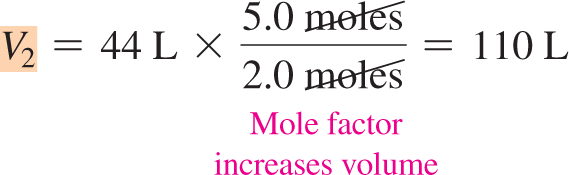
Application: Used to calculate the change in volume or amount when the other changes, with pressure and temperature constant.
Example: Adding helium to a weather balloon increases its volume, as shown below.

Gas Stoichiometry and Molar Volume
Molar Volume at STP
At standard temperature and pressure (STP: 0 °C and 1 atm), one mole of any ideal gas occupies 22.4 L. This relationship is used to convert between mass, moles, and volume of a gas at STP.
Key Equalities: 1 mole = 22.4 L (at STP); 1 mole = molar mass (g)
Application: Used to calculate the volume of a given mass of gas at STP, or the mass of a given volume.
Example: 64.0 g of O2 gas at STP occupies 44.8 L.


Dalton’s Law of Partial Pressures
Partial Pressure in Gas Mixtures
Dalton’s Law states that the total pressure of a gas mixture is the sum of the partial pressures of each component gas. The partial pressure of a gas is the pressure it would exert if it occupied the container alone.
Mathematical Expression:
Application: Used to calculate the partial pressure of a component in a mixture when the total pressure and the pressures of other components are known.
Example: In a heliox mixture with a total pressure of 7.00 atm and oxygen partial pressure of 1.50 atm, the partial pressure of helium is 5.50 atm.

Summary Table: Gas Laws and Their Applications
Law | Equation | Variables Held Constant | Direct/Inverse Relationship |
|---|---|---|---|
Boyle’s Law | T, n | Inverse (P & V) | |
Charles’s Law | P, n | Direct (V & T) | |
Gay-Lussac’s Law | V, n | Direct (P & T) | |
Avogadro’s Law | P, T | Direct (V & n) | |
Combined Gas Law | n | Multiple | |
Dalton’s Law | n/a | Sum of partial pressures |
