 뒤로
뒤로Redox Reactions: Oxidation and Reduction in Chemistry
스터디 가이드 - 스마트 노트
 자료에 맞춘 맞춤형 노트, 핵심 정의, 예시, 맥락을 확장해 제공합니다.
Redox Reactions
Introduction to Oxidation-Reduction (Redox) Reactions
Oxidation-reduction (redox) reactions are a fundamental class of chemical reactions in which electrons are transferred from one substance to another. These reactions are essential in both biological and industrial processes, and understanding them is crucial for GOB Chemistry students.
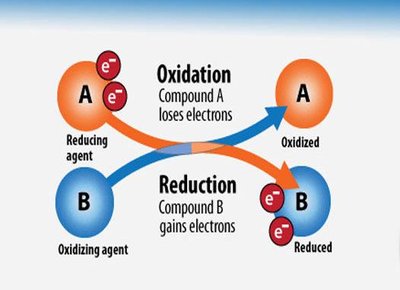
Oxidation: The process in which a substance loses electrons.
Reduction: The process in which a substance gains electrons.
Mnemonic: "LEO the lion says GER" (Lose Electrons Oxidize, Gain Electrons Reduce).
Key Features of Redox Reactions
Redox reactions involve the transfer of electrons between substances.
Metals typically lose electrons to form positive ions (are oxidized).
Non-metals typically gain electrons to form negative ions (are reduced).
Common real-world examples include the tarnishing of silver, rusting of iron, and the green patina on copper roofs.
Terminology in Redox Reactions
There are four main terms to understand when discussing redox reactions:
Oxidation: Loss of electrons by a substance.
Reduction: Gain of electrons by a substance.
Oxidizing Agent: The substance that gains electrons (is reduced).
Reducing Agent: The substance that loses electrons (is oxidized).
Half-Reaction Equations
Redox reactions can be separated into two half-reactions: one for oxidation and one for reduction. This helps in identifying which species is oxidized and which is reduced.
Oxidation Half-Reaction: Shows the loss of electrons.
Reduction Half-Reaction: Shows the gain of electrons.
Example:
The reaction between zinc and copper(II) sulfate:
Oxidation half:
Reduction half:
Spectator ions (e.g., ) do not participate in the redox process.
In this reaction:
Zinc is oxidized (loses electrons).
Copper is reduced (gains electrons).
Identifying Oxidation and Reduction in Equations
Example A: Sn is oxidized (loses electrons).
Example B: Fe3+ is reduced (gains electrons).
Example C: Cl2 is reduced (gains electrons).
Application Example: Light-Sensitive Sunglasses
In light-sensitive sunglasses, UV light initiates a redox reaction:
Oxidized: (loses electrons to form )
Reduced: (gains electrons to form )
Summary Table: Redox Terminology
Process | Electron Movement | Agent | Example |
|---|---|---|---|
Oxidation | Loss of electrons | Reducing agent | |
Reduction | Gain of electrons | Oxidizing agent |
Additional info:
Redox reactions are central to metabolic pathways, corrosion, energy production, and many industrial processes.
Understanding electron flow is essential for balancing redox equations and predicting reaction outcomes.
