 뒤로
뒤로Solutions: Properties, Electrolytes, Solubility, and Concentration
스터디 가이드 - 스마트 노트
 자료에 맞춘 맞춤형 노트, 핵심 정의, 예시, 맥락을 확장해 제공합니다.
Solutions and Their Properties
Definition and Components of Solutions
Solutions are homogeneous mixtures composed of two or more pure substances. The solvent is the component present in the greatest amount, while solutes are the substances dissolved in the solvent. For example, when sugar is dissolved in water, water is the solvent and sugar is the solute.
Electrolytic Properties of Solutions
Solutions can be classified based on their ability to conduct electricity:
Electrolytes: Substances whose aqueous solutions contain ions and conduct electricity (e.g., NaCl).
Nonelectrolytes: Substances that do not form ions in solution and do not conduct electricity (e.g., C12H22O11).
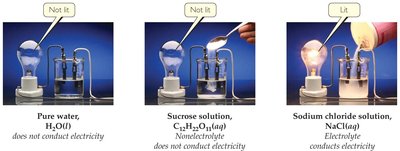
Example: Pure water and sucrose solution do not conduct electricity, while sodium chloride solution does, due to the presence of ions.
Ionic and Molecular Compounds in Water
Dissociation of Ionic Compounds
When ionic compounds dissolve in water, they dissociate into their constituent ions, which are then dispersed throughout the solution. This process is called dissociation:
For example:
Each ion is surrounded (solvated) by water molecules, preventing recombination.
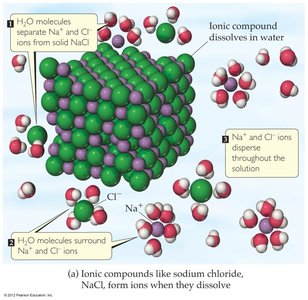
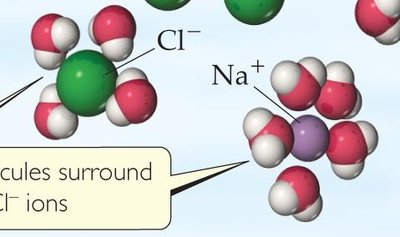
Water as an Effective Solvent
Water is an electrically neutral molecule but is highly effective at dissolving ionic compounds due to its polarity. The oxygen atom in water has a partial negative charge (δ−), while the hydrogen atoms have partial positive charges (δ+).
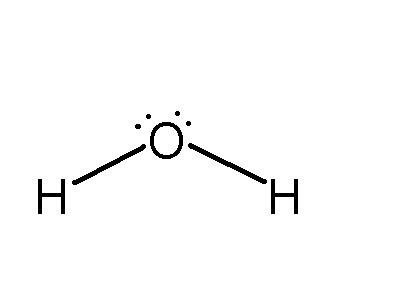
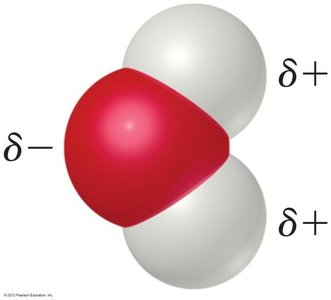
This polarity allows water molecules to surround and stabilize ions in solution, facilitating dissolution.
Molecular Compounds in Water
When molecular compounds (such as methanol, CH3OH) dissolve in water, they typically remain as intact molecules and do not form ions.
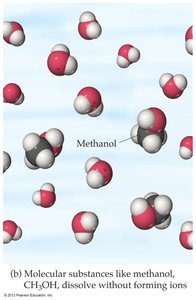
Example: Methanol dissolves in water without forming ions, so it does not conduct electricity.
Solubility and Solubility Guidelines
Solubility of Ionic Compounds
Solubility is the maximum amount of a substance that can dissolve in a given quantity of solvent at a specific temperature. Solubility rules help predict whether an ionic compound will dissolve in water.
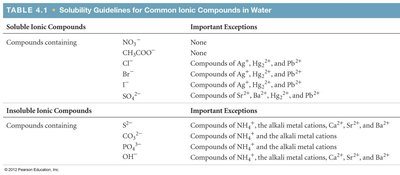
Soluble Ionic Compounds | Important Exceptions |
|---|---|
NO3-, CH3COO- | None |
Cl-, Br-, I- | Compounds of Ag+, Hg22+, Pb2+ |
SO42- | Compounds of Sr2+, Ba2+, Hg22+, Pb2+ |
Insoluble Ionic Compounds | Important Exceptions |
S2-, CO32-, PO43-, OH- | Compounds of NH4+, alkali metal cations, Ca2+, Sr2+, Ba2+ |
Example: All common ionic compounds of group 1A ions and NH4+ are soluble in water.
Predicting Solubility and Precipitation Reactions
Solubility rules are used to predict whether a precipitate will form when two solutions are mixed. For example:
(Ag2CO3 precipitates)
Temperature Effects on Solubility
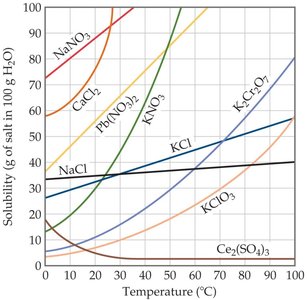
The solubility of most solid solutes in water increases as temperature increases. This relationship can be visualized in a solubility curve graph.
Ionic Equations
Molecular, Complete Ionic, and Net Ionic Equations
Chemical reactions in aqueous solutions can be represented in three ways:
Molecular equation: Shows reactants and products as compounds (e.g., )
Complete ionic equation: Shows all strong electrolytes as ions.
Net ionic equation: Includes only the ions and molecules directly involved in the reaction, omitting spectator ions.
Example:
Complete ionic:
Net ionic:
Note: The sum of ionic charges must be the same on both sides of the balanced equation. Solids, liquids, and gases do not separate into ions in solution.
Concentration of Solutions
Definition and Units
Concentration expresses the amount of solute dissolved in a given quantity of solvent or solution. The most common unit is molarity (M):
Other ways to express concentration include:
Percent by mass (% w/w):
Percent by volume (% v/v):
Percent mass/volume (% w/v):
Example: Dissolving 21.0 g of NaF in enough water to make 500. mL of solution gives a 1.00 M NaF solution.
Interconverting Molarity, Moles, and Volume
Given any two of the following—molarity (M), moles of solute (mol), or volume of solution (L)—the third can be calculated:
Example: How many moles of solute are in 2.00 L of a 0.200 M solution of HNO3?
Dilution of Solutions
Principle of Dilution
To prepare a solution of lower concentration from a more concentrated stock solution, water is added. The number of moles of solute remains constant before and after dilution:
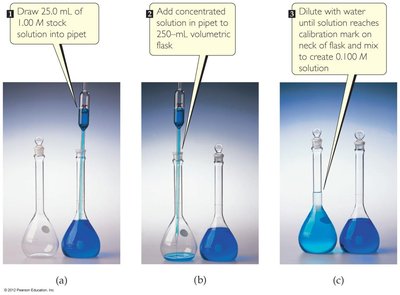
Example: To make 450 mL of 0.10 M H2SO4 from a 3.0 M stock solution, use the dilution equation to find the required volume of stock solution.
