 뒤로
뒤로The Mole and Calculating Molar Mass: Study Notes for GOB Chemistry
스터디 가이드 - 스마트 노트
 자료에 맞춘 맞춤형 노트, 핵심 정의, 예시, 맥락을 확장해 제공합니다.
The Mole and Calculating Molar Mass
Introduction to the Mole
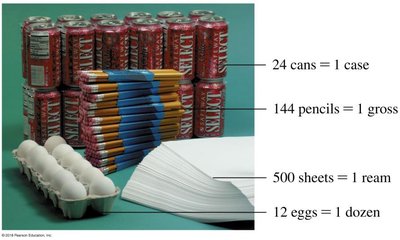
The concept of the mole is fundamental in chemistry for quantifying the amount of substance. Just as terms like dozen, gross, and ream are used to count specific quantities of items, the mole is used to count particles such as atoms, molecules, or ions in chemical substances.
Mole: A counting unit in chemistry, analogous to terms like dozen (12), gross (144), or ream (500).
Purpose: Enables chemists to work with amounts of substances large enough to be practical for laboratory and industrial use.
Avogadro’s Number
Avogadro’s number defines the quantity of particles in one mole of any substance. This constant allows chemists to relate the macroscopic scale of grams and liters to the microscopic scale of atoms and molecules.
Avogadro’s Number: items per mole.
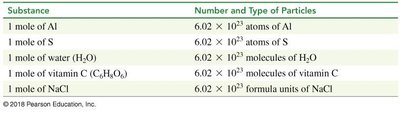
1 mole of any element contains atoms.
1 mole of any molecular compound contains molecules.
1 mole of an ionic compound contains formula units.
Examples:
1 mole of carbon contains C atoms.
1 mole of CO2 contains molecules of CO2.
1 mole of NaCl contains formula units of NaCl.
Conversions Using Avogadro’s Number
Avogadro’s number is used as a conversion factor between the number of moles and the number of particles (atoms, molecules, or ions). This is essential for stoichiometric calculations in chemistry.
Conversion Factors:
particles
particles mole
Steps for Conversion:
State the given and needed quantities.
Write a plan to convert moles to atoms/molecules (or vice versa).
Use Avogadro’s number to write conversion factors.
Set up and solve the calculation.
Example Calculation:
Number of atoms in 2.0 moles of Al: atoms of Al
Number of moles in atoms of S: moles of S
Moles of Elements in Compounds
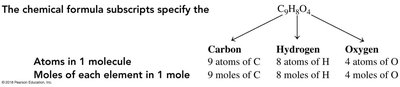
The subscripts in a chemical formula indicate the number of atoms of each element in one molecule, and also the number of moles of each element in one mole of the compound.
Example: Aspirin (C9H8O4)
1 molecule contains 9 C, 8 H, and 4 O atoms.
1 mole contains 9 moles C, 8 moles H, and 4 moles O.
Conversion Factors from Chemical Formulas:
From C9H8O4:
Example Calculation:
How many moles of C in 1.5 moles of aspirin?
moles C
Molar Mass
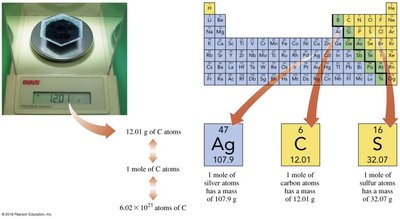
The molar mass is the mass of one mole of a substance, expressed in grams per mole (g/mol). For elements, it is numerically equal to the atomic mass from the periodic table, but expressed in grams.
Molar Mass of an Element: The atomic mass in grams (e.g., 1 mole of C = 12.01 g).
Molar Mass of a Compound: The sum of the molar masses of all atoms in the formula.
Steps to Calculate Molar Mass of a Compound:
Obtain the molar mass of each element (from the periodic table).
Multiply the molar mass of each element by its subscript in the formula.
Add the masses for all elements to get the total molar mass.
Example: Calculate the molar mass of Li2CO3:
Li: g
C: g
O: g
Total molar mass: g/mol
Using Molar Mass in Calculations
Molar mass is a key conversion factor for converting between grams and moles of a substance. This is essential for laboratory calculations and chemical reactions.
Conversion Factors:
Example: 1 mole of Ag = 107.9 g of Ag
For compounds: 1 mole of H2O = 18.02 g of H2O
Example Calculation:
How many moles of water are in 59.8 g of H2O?
moles of H2O
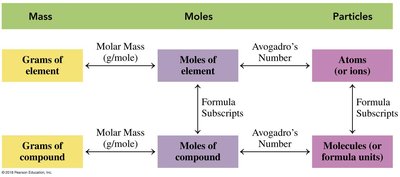
Summary Table: Mass, Moles, and Particles
The following table summarizes the relationships and conversion factors between mass, moles, and particles for elements and compounds:
Quantity | Conversion Factor | To |
|---|---|---|
Grams of element | Molar Mass (g/mol) | Moles of element |
Moles of element | Avogadro's Number | Atoms (or ions) |
Grams of compound | Molar Mass (g/mol) | Moles of compound |
Moles of compound | Avogadro's Number | Molecules (or formula units) |
References: Timberlake, K. (2018). Chemistry: Introduction to general, organic and biological chemistry (13th ed.). Pearson Education.
