 뒤로
뒤로Water, pH, and Reactions of Acids and Bases
스터디 가이드 - 스마트 노트
 자료에 맞춘 맞춤형 노트, 핵심 정의, 예시, 맥락을 확장해 제공합니다.
Water, pH, and Reactions of Acids and Bases
Water as an Amphiprotic Substance
Water is a unique molecule in chemistry because it can act as both an acid and a base, a property known as amphiprotic. This means water can either donate a hydrogen ion (H+) or accept one, depending on the other reactant present. Bicarbonate (HCO3-) is another example of an amphiprotic substance. The behavior of an amphiprotic substance is determined by the strength of the acid or base it reacts with.
Acts as an acid: Donates H+ to a stronger base.
Acts as a base: Accepts H+ from a stronger acid.

Water Dissociation Expression (Kw)
The water dissociation constant (Kw) describes the equilibrium between water molecules and their ions in aqueous solution. At 25°C, Kw is always:
[H3O+]: Concentration of hydronium ions
[OH-]: Concentration of hydroxide ions
Knowing one ion concentration allows calculation of the other using Kw.
The pH Scale
Understanding pH
The pH scale is a logarithmic scale used to describe the acidity or basicity of a solution. It ranges from 0 (most acidic) to 14 (most basic), with 7 being neutral. The pH value is determined by the concentration of hydronium ions in solution:
Acidic solution: [H3O+] > [OH-], pH < 7
Neutral solution: [H3O+] = [OH-], pH = 7
Basic solution: [H3O+] < [OH-], pH > 7
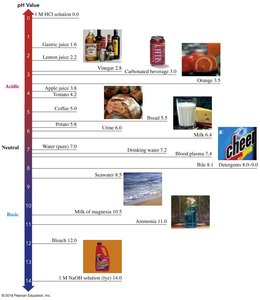
Example: Lemon juice (pH ≈ 2.2) is much more acidic than milk (pH ≈ 6.4).
Measuring pH
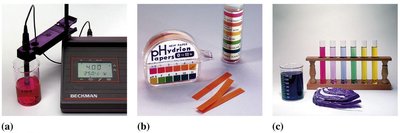
There are several methods to measure the pH of a solution:
pH meters: Provide a digital readout of pH.
Indicator papers/solutions: Change color based on pH; colors are compared to a chart.
Calculating pH and [H3O+]
The pH scale is logarithmic, meaning each unit change represents a tenfold change in [H3O+]. The formulas are:
A solution with pH 2 has ten times more [H3O+] than one with pH 3.
Calculators are often used for these calculations.
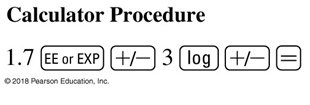
Example: To find the pH of a solution with [H3O+] = 1.7 × 10⁻³ M, use the formula above.
Neutralization Reactions
Acid-Base Neutralization
Neutralization reactions occur when an acid reacts with a base to produce water and a salt. The general reaction is:
For example:
Balancing is important: one H+ reacts with one OH- to form water. Coefficients may be needed for polyprotic acids or bases.
Example:
Buffers and Their Biological Importance
What Are Buffers?
Buffers are solutions that resist drastic changes in pH when small amounts of acid or base are added. They are crucial in biological systems, such as maintaining blood pH between 7.35 and 7.45.
Contain a weak acid and its conjugate base (or vice versa).
Neutralize added acids (H3O+) or bases (OH-).
Do not neutralize each other under normal conditions.
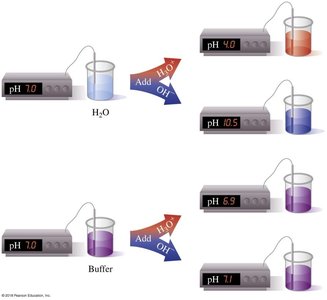
Example: In blood, the carbonic acid/bicarbonate buffer system helps maintain pH stability.
How Buffers Work (Le Chatelier’s Principle)
Buffers use Le Chatelier’s Principle to shift equilibrium and minimize pH changes. A typical buffer system is:
Add acid: Extra H3O+ combines with C2H3O2-, shifting equilibrium to the left, maintaining pH.
Add base: Added OH- is neutralized by HC2H3O2, shifting equilibrium to the right, maintaining pH.
Biological Application: Buffers are essential for life, as enzymes and metabolic processes require a stable pH environment.
References: Timberlake, K. (2018). Chemistry: Introduction to general, organic and biological chemistry. (13th ed). Pearson Education.
