Ch.18 Metabolic Pathways and ATP Production
Timberlake - Chemistry: An Introduction to General, Organic, and Biological Chemistry 13th Edition
Timberlake13th EditionChemistry: An Introduction to General, Organic, and Biological ChemistryISBN: 9780134421353당신이 사용하는 게 아니라요?교과서 변경
18장, 문제 40

What is the total NADH and total FADH2 produced in one turn of the citric acid cycle?

검증된 단계별 안내
1
Step 1: Understand the citric acid cycle (also known as the Krebs cycle or TCA cycle). It is a series of chemical reactions used by aerobic organisms to generate energy through the oxidation of acetyl-CoA derived from carbohydrates, fats, and proteins.
Step 2: Recall that during one turn of the citric acid cycle, specific molecules are produced as intermediates are oxidized. NADH and FADH₂ are generated as electron carriers during these oxidation steps.
Step 3: Identify the steps in the citric acid cycle where NADH is produced. NADH is formed during three specific reactions: (1) the conversion of isocitrate to α-ketoglutarate, (2) the conversion of α-ketoglutarate to succinyl-CoA, and (3) the conversion of malate to oxaloacetate.
Step 4: Identify the step in the citric acid cycle where FADH₂ is produced. FADH₂ is formed during the conversion of succinate to fumarate.
Step 5: Sum up the total NADH and FADH₂ produced in one turn of the cycle. Based on the reactions identified, three NADH molecules and one FADH₂ molecule are produced per turn of the citric acid cycle.

비슷한 문제에 대한 검증된 영상 답변:

이 영상 해법은 위 문제에 도움이 된다고 튜터들이 추천한 것입니다.
영상 길이:
1m

주요 개념

질문에 올바르게 답하기 위해 반드시 이해해야 하는 핵심 개념들은 다음과 같습니다.

Citric Acid Cycle

The citric acid cycle, also known as the Krebs cycle, is a series of enzymatic reactions that occur in the mitochondria. It plays a crucial role in cellular respiration by oxidizing acetyl-CoA to produce energy carriers. Each turn of the cycle generates high-energy molecules, which are essential for ATP production.
추천 영상:
가이드 코스
2:31
Citric Acid Cycle Summary Concept 12

NADH and FADH₂

NADH and FADH₂ are electron carriers produced during the citric acid cycle. NADH is generated from the reduction of NAD⁺, while FADH₂ is produced from the reduction of FAD. These molecules transport electrons to the electron transport chain, where they contribute to ATP synthesis through oxidative phosphorylation.
추천 영상:
가이드 코스
1:43
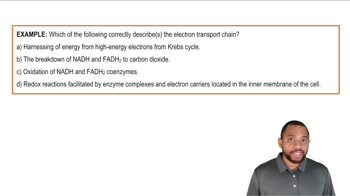
Intro to Electron Transport Chain Example 1

Energy Yield of the Citric Acid Cycle

In one turn of the citric acid cycle, a total of three NADH and one FADH₂ are produced. This energy yield is critical for understanding the cycle's efficiency in generating ATP. The NADH and FADH₂ produced are then used in the electron transport chain to produce a significant amount of ATP, highlighting the cycle's importance in cellular metabolism.
추천 영상:
가이드 코스
2:31
Citric Acid Cycle Summary Concept 12