Ch.10 Acids and Bases and Equilibrium
Timberlake - Chemistry: An Introduction to General, Organic, and Biological Chemistry 14th Edition
Timberlake14th EditionChemistry: An Introduction to General, Organic, and Biological ChemistryISBN: 9781292472249당신이 사용하는 게 아니라요?교과서 변경
10장, 문제 99a

A buffer solution is made by dissolving H3PO4 and NaH2PO4 in water.
a. Write an equation that shows how this buffer neutralizes added acid.

검증된 단계별 안내
1
Identify the components of the buffer solution: The buffer consists of H₃PO₄ (phosphoric acid, a weak acid) and NaH₂PO₄ (sodium dihydrogen phosphate, its conjugate base). This combination allows the buffer to neutralize both added acid and base.
Understand the role of each component: H₃PO₄ can donate protons (H⁺) to neutralize added base, while NaH₂PO₄ can accept protons to neutralize added acid. In this case, we are focusing on how the buffer neutralizes added acid.
Write the reaction for the conjugate base (H₂PO₄⁻) reacting with the added acid (H⁺): When an acid is added to the buffer, the H⁺ ions from the acid are neutralized by the conjugate base, H₂PO₄⁻.
Express the neutralization reaction in chemical equation form: H2PO4-+H+H3PO4
Verify the reaction: Ensure that the reaction shows the conjugate base (H₂PO₄⁻) accepting a proton (H⁺) to form the weak acid (H₃PO₄), which is consistent with the buffer's ability to neutralize added acid.

비슷한 문제에 대한 검증된 영상 답변:

이 영상 해법은 위 문제에 도움이 된다고 튜터들이 추천한 것입니다.
영상 길이:
4m
도움이 되었나요?

주요 개념

질문에 올바르게 답하기 위해 반드시 이해해야 하는 핵심 개념들은 다음과 같습니다.

Buffer Solutions

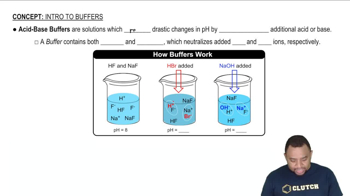
A buffer solution is a system that resists changes in pH when small amounts of acid or base are added. It typically consists of a weak acid and its conjugate base, or a weak base and its conjugate acid. In this case, H₃PO₄ (phosphoric acid) acts as the weak acid, while NaH₂PO₄ (sodium dihydrogen phosphate) provides the conjugate base, helping to maintain a stable pH.
추천 영상:
가이드 코스
03:02
Buffer Solutions

Neutralization Reaction

A neutralization reaction occurs when an acid reacts with a base to form water and a salt. In the context of a buffer, when an acid is added, the conjugate base present in the buffer will react with the added acid to minimize pH changes. For example, the conjugate base from NaH₂PO₄ will react with H⁺ ions from the added acid, effectively neutralizing them.
추천 영상:
가이드 코스
00:37
Lewis Dot Structures: Neutral Compounds (Simplified) Concept 1

Equilibrium in Buffer Systems

Buffer systems operate based on the principles of chemical equilibrium. The addition of an acid shifts the equilibrium of the buffer reaction, allowing the system to absorb excess H⁺ ions without a significant change in pH. This dynamic balance between the weak acid and its conjugate base is crucial for the buffer's ability to maintain pH stability in the solution.
추천 영상:
가이드 코스
03:04
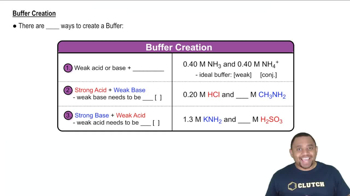
Buffer Creation Methods