Ch.10 Acids and Bases and Equilibrium
Timberlake - Chemistry: An Introduction to General, Organic, and Biological Chemistry 14th Edition
Timberlake14th EditionChemistry: An Introduction to General, Organic, and Biological ChemistryISBN: 9781292472249당신이 사용하는 게 아니라요?교과서 변경
10장, 문제 34a

Calculate the [H3O+] of each aqueous solution with the following [OH-]:
a. baking soda, 1.0 × 10⁻⁶ M

검증된 단계별 안내
1
Step 1: Recall the relationship between [H₃O⁺] and [OH⁻] in aqueous solutions, which is given by the ion-product constant for water: K_w = [H₃O⁺][OH⁻]. At 25°C, K_w = 1.0 \(\times\) 10^{-14}.
Step 2: Rearrange the equation to solve for [H₃O⁺]: [H₃O⁺] = \(\frac{K_w}{[OH⁻]}\).
Step 3: Substitute the given value of [OH⁻] into the equation. For baking soda, [OH⁻] = 1.0 \(\times\) 10^{-6} \(\text{ M}\). The equation becomes: [H₃O⁺] = \(\frac{1.0 \times 10^{-14}\)}{1.0 \(\times\) 10^{-6}}.
Step 4: Simplify the expression by dividing the values in the numerator and denominator. Use the rules of exponents: \(\frac{10^{-14}\)}{10^{-6}} = 10^{-14 + 6} = 10^{-8}.
Step 5: Conclude that the [H₃O⁺] for the solution is 1.0 \(\times\) 10^{-8} \(\text{ M}\). This indicates the solution is slightly basic, as [H₃O⁺] is less than 1.0 \(\times\) 10^{-7} \(\text{ M}\).

비슷한 문제에 대한 검증된 영상 답변:

이 영상 해법은 위 문제에 도움이 된다고 튜터들이 추천한 것입니다.
영상 길이:
1m

주요 개념

질문에 올바르게 답하기 위해 반드시 이해해야 하는 핵심 개념들은 다음과 같습니다.

pH and pOH Relationship

The pH and pOH of a solution are related through the equation pH + pOH = 14 at 25°C. This relationship allows us to calculate one from the other. Since pH measures the concentration of hydrogen ions [H₃O⁺] and pOH measures the concentration of hydroxide ions [OH⁻], knowing one enables the determination of the other, which is essential for understanding acid-base chemistry.
추천 영상:
가이드 코스
00:48
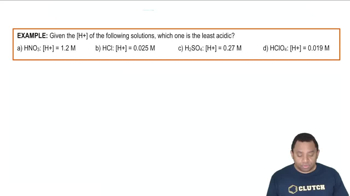
Least Acidic Solution Example

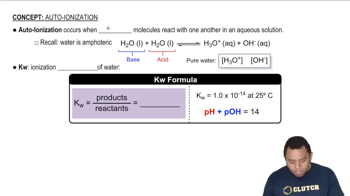
Ion Product of Water (Kw)

The ion product of water (Kw) is a constant that equals 1.0 x 10⁻¹⁴ at 25°C, representing the product of the concentrations of hydrogen ions [H₃O⁺] and hydroxide ions [OH⁻]. This means that in any aqueous solution, the product of [H₃O⁺] and [OH⁻] will always equal Kw. This concept is crucial for calculating the concentration of [H₃O⁺] when [OH⁻] is known.
추천 영상:
가이드 코스
02:22
Auto-Ionization and Kw

Calculating [H₃O⁺] from [OH⁻]

To find the concentration of hydronium ions [H₃O⁺] from a given concentration of hydroxide ions [OH⁻], you can use the formula [H₃O⁺] = Kw / [OH⁻]. By substituting the known value of [OH⁻] into this equation, you can determine the corresponding [H₃O⁺] concentration, which is essential for understanding the acidity of the solution.
추천 영상:
가이드 코스
03:12
Calculating Molar Mass Example 1