Ch.10 Acids and Bases and Equilibrium
Timberlake - Chemistry: An Introduction to General, Organic, and Biological Chemistry 14th Edition
Timberlake14th EditionChemistry: An Introduction to General, Organic, and Biological ChemistryISBN: 9781292472249당신이 사용하는 게 아니라요?교과서 변경
10장, 문제 27

In an acidic solution, how does the concentration of H3O+ compare to the concentration of OH-?

검증된 단계별 안내
1
Understand that in any aqueous solution, the concentrations of H₃O⁺ (hydronium ions) and OH⁻ (hydroxide ions) are related by the ion-product constant for water, Kw, which is 1.0 × 10⁻¹⁴ at 25°C. This relationship is expressed as: Kw = [H3O+] × [OH].
Recognize that an acidic solution is defined as one where the concentration of H₃O⁺ is greater than the concentration of OH⁻. This means: [H3O+] > [OH].
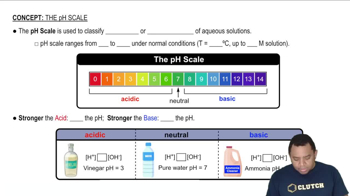
Recall that the pH of a solution is a measure of its acidity and is calculated using the formula: pH = −log[H3O+]. For an acidic solution, the pH is less than 7.
Use the relationship between pH and pOH, which is given by: pH + pOH = 14. In an acidic solution, since the pH is less than 7, the pOH will be greater than 7, indicating a lower concentration of OH⁻.
Conclude that in an acidic solution, the concentration of H₃O⁺ is higher than the concentration of OH⁻, and this imbalance is what defines the solution as acidic.

비슷한 문제에 대한 검증된 영상 답변:

이 영상 해법은 위 문제에 도움이 된다고 튜터들이 추천한 것입니다.
영상 길이:
1m
도움이 되었나요?

주요 개념

질문에 올바르게 답하기 위해 반드시 이해해야 하는 핵심 개념들은 다음과 같습니다.

Acidic Solutions

An acidic solution is characterized by a higher concentration of hydronium ions (H₃O⁺) compared to hydroxide ions (OH⁻). This imbalance results in a pH value less than 7, indicating acidity. In such solutions, the presence of H₃O⁺ ions is what defines the solution as acidic, affecting various chemical reactions and properties.
추천 영상:

pH Scale

The pH scale quantifies the acidity or basicity of a solution, ranging from 0 to 14. A pH less than 7 indicates an acidic solution, where the concentration of H₃O⁺ is greater than that of OH⁻. Each unit change in pH represents a tenfold change in H₃O⁺ concentration, making it a crucial tool for understanding the nature of solutions.
추천 영상:

Ion Product of Water

The ion product of water (Kw) is the equilibrium constant for the self-ionization of water, defined as Kw = [H₃O⁺][OH⁻] = 1.0 x 10⁻¹⁴ at 25°C. In acidic solutions, as the concentration of H₃O⁺ increases, the concentration of OH⁻ must decrease to maintain this constant. This relationship is fundamental in determining the balance of ions in any aqueous solution.
추천 영상:
가이드 코스
01:37
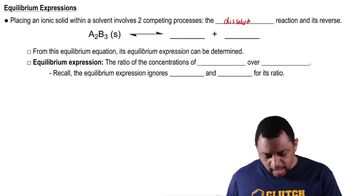
Solubility Product Constant (Ksp) Concept 2