Ch.11 Introduction to Organic Chemistry: Hydrocarbons
Timberlake - Chemistry: An Introduction to General, Organic, and Biological Chemistry 14th Edition
Timberlake14th EditionChemistry: An Introduction to General, Organic, and Biological ChemistryISBN: 9781292472249당신이 사용하는 게 아니라요?교과서 변경
11장, 문제 17b

Draw the line-angle formula for each of the following:
b. ethylcyclopentane

검증된 단계별 안내
1
Understand the structure of ethylcyclopentane: It consists of a cyclopentane ring (a five-membered ring of carbon atoms) with an ethyl group (-CH₂CH₃) attached to one of the carbon atoms in the ring.
Start by drawing the cyclopentane ring. Represent it as a pentagon since each vertex of the pentagon corresponds to a carbon atom.
Choose one vertex of the pentagon to attach the ethyl group. Draw a line extending from that vertex to represent the bond connecting the ethyl group to the cyclopentane ring.
Add the ethyl group to the extended line. The ethyl group consists of two carbon atoms: the first carbon is directly bonded to the cyclopentane ring, and the second carbon is bonded to the first carbon. Represent this as a short line segment branching off the first line.
Ensure that all implied hydrogens are understood: Each carbon atom in the structure should have a total of four bonds. Hydrogens are not explicitly drawn in line-angle formulas but are implied to complete the valency of carbon.

비슷한 문제에 대한 검증된 영상 답변:

이 영상 해법은 위 문제에 도움이 된다고 튜터들이 추천한 것입니다.

주요 개념

질문에 올바르게 답하기 위해 반드시 이해해야 하는 핵심 개념들은 다음과 같습니다.

Line-Angle Formula

The line-angle formula, also known as the skeletal formula, is a simplified representation of organic molecules. In this format, vertices represent carbon atoms, and lines represent bonds between them. Hydrogen atoms are typically omitted for carbon atoms, as they are assumed to have enough hydrogen to satisfy carbon's tetravalency. This method allows for a clearer and more efficient depiction of complex structures.
추천 영상:
가이드 코스
01:24
Bond Angles (Simplified) Concept 1

Cycloalkanes

Cycloalkanes are a class of hydrocarbons characterized by carbon atoms arranged in a ring structure. They follow the general formula CnH2n, where 'n' is the number of carbon atoms. Ethylcyclopentane specifically consists of a five-membered carbon ring (cyclopentane) with an ethyl group (C2H5) attached to one of the carbons in the ring. Understanding cycloalkanes is essential for accurately drawing their line-angle formulas.
추천 영상:
가이드 코스
0:36
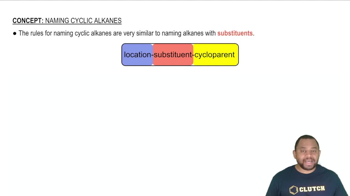
Rules for Naming Cyclic Alkanes Concept 1

Substituents in Organic Chemistry

Substituents are atoms or groups of atoms that replace hydrogen atoms in a hydrocarbon chain or ring. In the case of ethylcyclopentane, the ethyl group acts as a substituent on the cyclopentane ring. Recognizing how substituents affect the structure and naming of organic compounds is crucial for drawing accurate representations and understanding the properties of the molecule.
추천 영상:
가이드 코스
2:26
Introduction to Organic Chemistry Concept 1