Ch.13 Carbohydrates
Timberlake - Chemistry: An Introduction to General, Organic, and Biological Chemistry 14th Edition
Timberlake14th EditionChemistry: An Introduction to General, Organic, and Biological ChemistryISBN: 9781292472249당신이 사용하는 게 아니라요?교과서 변경
13장, 문제 17a

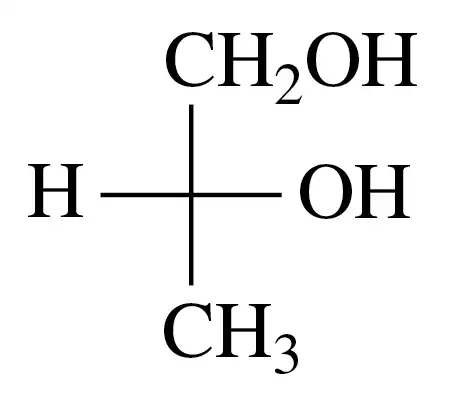
Identify each of the following as D or L:
a. Structural formula of a carbohydrate showing hydroxyl groups and hydrogen atoms for identifying D or L enantiomers.

검증된 단계별 안내
1
Step 1: Understand the D and L notation. The D and L system is used to describe the configuration of chiral molecules, particularly sugars and amino acids. It is based on the molecule's relationship to glyceraldehyde, the simplest chiral sugar. D and L do not refer to the direction of optical rotation but to the spatial arrangement of groups around the chiral carbon.
Step 2: Locate the chiral carbon farthest from the carbonyl group (C=O) in the molecule. This carbon is the reference point for determining whether the molecule is D or L.
Step 3: Examine the orientation of the hydroxyl group (-OH) attached to the reference chiral carbon. If the -OH group is on the right side of the Fischer projection, the molecule is classified as D. If the -OH group is on the left side, the molecule is classified as L.
Step 4: Carefully analyze the Fischer projection of the molecule provided in the image. Identify the position of the -OH group on the reference chiral carbon.
Step 5: Based on the position of the -OH group, assign the molecule as either D or L. If the -OH is on the right, it is D; if it is on the left, it is L.

비슷한 문제에 대한 검증된 영상 답변:

이 영상 해법은 위 문제에 도움이 된다고 튜터들이 추천한 것입니다.
영상 길이:
1m
도움이 되었나요?

주요 개념

질문에 올바르게 답하기 위해 반드시 이해해야 하는 핵심 개념들은 다음과 같습니다.

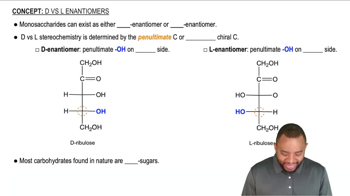
D and L Stereochemistry

D and L refer to the stereochemical configuration of molecules, particularly amino acids and sugars. 'D' (dextrorotatory) indicates that a molecule rotates plane-polarized light to the right, while 'L' (levorotatory) indicates a leftward rotation. This classification is based on the molecule's relationship to glyceraldehyde, with D and L designations corresponding to the orientation of the hydroxyl group on the penultimate carbon.
추천 영상:
가이드 코스
1:30
D vs L Enantiomers Concept 1

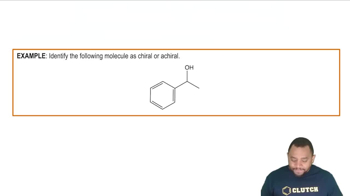
Chirality

Chirality is a property of a molecule that makes it non-superimposable on its mirror image, much like left and right hands. Chiral molecules often exist in two forms, known as enantiomers, which can have different biological activities. Understanding chirality is crucial for determining the D or L configuration of a compound, as it influences how the molecule interacts with biological systems.
추천 영상:
가이드 코스
1:39
Chirality Example 1

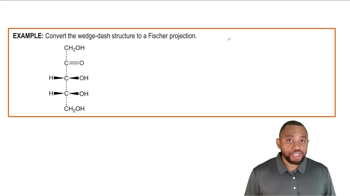
Fischer Projection

The Fischer projection is a two-dimensional representation of a three-dimensional organic molecule, commonly used for sugars and amino acids. In this format, the vertical lines represent bonds going back in space, while horizontal lines represent bonds coming forward. This method simplifies the visualization of stereochemistry, making it easier to identify whether a compound is in the D or L configuration based on the orientation of its functional groups.
추천 영상:
가이드 코스
0:48
Fischer Projections Example 1