Ch.15 Lipids
Timberlake - Chemistry: An Introduction to General, Organic, and Biological Chemistry 14th Edition
Timberlake14th EditionChemistry: An Introduction to General, Organic, and Biological ChemistryISBN: 9781292472249당신이 사용하는 게 아니라요?교과서 변경
15장, 문제 84

Which of the following are found in cell membranes?
a. proteins
b. waxes
c. phospholipids

검증된 단계별 안내
1
Understand the structure of a cell membrane: The cell membrane is a lipid bilayer that acts as a barrier and regulates the movement of substances in and out of the cell. It is primarily composed of specific types of molecules.
Recall the key components of the cell membrane: The main components are phospholipids, proteins, and cholesterol. Phospholipids form the bilayer structure, while proteins are embedded within or attached to the bilayer, serving various functions such as transport and signaling.
Evaluate the role of phospholipids: Phospholipids are amphipathic molecules (having both hydrophilic and hydrophobic regions) that form the fundamental structure of the membrane. They are essential for the bilayer's formation and function.
Consider the role of proteins: Proteins in the membrane can act as channels, receptors, or enzymes. They are crucial for communication and transport across the membrane.
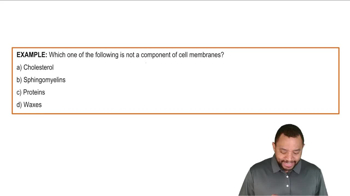
Analyze the presence of waxes: Waxes are not typically found in cell membranes. They are more commonly associated with protective coatings on surfaces, such as in plants or on the skin of animals, rather than being a structural component of membranes.

비슷한 문제에 대한 검증된 영상 답변:

이 영상 해법은 위 문제에 도움이 된다고 튜터들이 추천한 것입니다.
영상 길이:
2m

주요 개념

질문에 올바르게 답하기 위해 반드시 이해해야 하는 핵심 개념들은 다음과 같습니다.

Cell Membrane Structure

Cell membranes are primarily composed of a phospholipid bilayer, which provides a flexible barrier around the cell. This bilayer consists of hydrophilic (water-attracting) heads and hydrophobic (water-repelling) tails, allowing for selective permeability. The arrangement of these molecules is crucial for maintaining the integrity and functionality of the cell.
추천 영상:
가이드 코스
1:00
Cell Membranes Example 1

Membrane Proteins

Proteins embedded in the cell membrane play vital roles in various functions, including transport, signaling, and structural support. These proteins can be integral, spanning the membrane, or peripheral, attached to the surface. Their diverse functions are essential for communication and interaction with the cell's environment.
추천 영상:
가이드 코스
1:00
Cell Membranes Example 1

Phospholipids

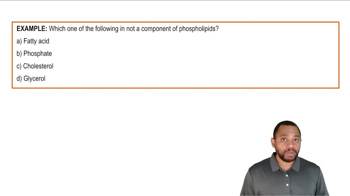
Phospholipids are a key component of cell membranes, consisting of a glycerol backbone, two fatty acid tails, and a phosphate group. Their unique structure allows them to form bilayers, which are fundamental to membrane integrity. Phospholipids also contribute to the fluidity and flexibility of the membrane, enabling the movement of proteins and other molecules.
추천 영상:
가이드 코스
1:01
Glycerophospholipids Example 1