Ch.16 Amino Acids, Proteins, and Enzymes
Timberlake - Chemistry: An Introduction to General, Organic, and Biological Chemistry 14th Edition
Timberlake14th EditionChemistry: An Introduction to General, Organic, and Biological ChemistryISBN: 9781292472249당신이 사용하는 게 아니라요?교과서 변경
16장, 문제 37a

Write an equation that represents an enzyme-catalyzed reaction.

검증된 단계별 안내
1
Understand that an enzyme-catalyzed reaction involves a substrate (reactant) binding to an enzyme to form an enzyme-substrate complex, which then converts into the product and releases the enzyme.
Write the general form of the reaction: \( \text{E} + \text{S} \rightarrow \text{ES} \rightarrow \text{E} + \text{P} \), where \( \text{E} \) is the enzyme, \( \text{S} \) is the substrate, \( \text{ES} \) is the enzyme-substrate complex, and \( \text{P} \) is the product.
Recognize that the enzyme \( \text{E} \) is not consumed in the reaction and can catalyze multiple cycles of substrate conversion.
Ensure the equation reflects the catalytic nature of the enzyme, showing that it facilitates the reaction without being permanently altered.
Use this general equation as a template to represent specific enzyme-catalyzed reactions, such as \( \text{E} + \text{ATP} \rightarrow \text{E-ATP} \rightarrow \text{E} + \text{ADP} + \text{P_i} \) for ATP hydrolysis catalyzed by an enzyme.

비슷한 문제에 대한 검증된 영상 답변:

이 영상 해법은 위 문제에 도움이 된다고 튜터들이 추천한 것입니다.
영상 길이:
58s
도움이 되었나요?

주요 개념

질문에 올바르게 답하기 위해 반드시 이해해야 하는 핵심 개념들은 다음과 같습니다.

Enzyme-Catalyzed Reaction

An enzyme-catalyzed reaction is a biochemical process where an enzyme accelerates a chemical reaction by lowering the activation energy required. Enzymes are specific proteins that bind to substrates, forming an enzyme-substrate complex, which then transforms into products. This process is crucial in metabolic pathways and cellular functions.
추천 영상:
가이드 코스
0:47
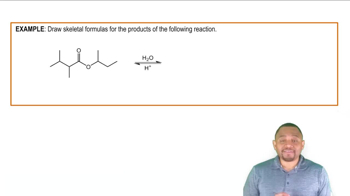
Acid-Catalyzed Ester Hydrolysis Example 1

Reaction Equation

A reaction equation is a symbolic representation of a chemical reaction, showing the reactants and products involved. In the context of enzyme-catalyzed reactions, the equation typically includes the enzyme, substrates, and products, illustrating how substrates are converted into products through the action of the enzyme. For example, E + S ↔ ES → E + P, where E is the enzyme, S is the substrate, and P is the product.
추천 영상:
가이드 코스
01:13
Thermochemical Equations

Michaelis-Menten Kinetics

Michaelis-Menten kinetics describes the rate of enzyme-catalyzed reactions as a function of substrate concentration. It provides a mathematical model that helps predict how changes in substrate levels affect the reaction rate, characterized by parameters such as Vmax (maximum reaction rate) and Km (Michaelis constant). This model is fundamental for understanding enzyme efficiency and regulation.
추천 영상:
가이드 코스
01:19
Kinetic Molecular Theory Concept 1