Ch.16 Amino Acids, Proteins, and Enzymes
Timberlake - Chemistry: An Introduction to General, Organic, and Biological Chemistry 14th Edition
Timberlake14th EditionChemistry: An Introduction to General, Organic, and Biological ChemistryISBN: 9781292472249당신이 사용하는 게 아니라요?교과서 변경
16장, 문제 37b

How is the active site different from the whole enzyme structure?

검증된 단계별 안내
1
Understand the concept of an enzyme: Enzymes are biological catalysts made up of proteins that speed up chemical reactions in living organisms. They have a specific three-dimensional structure that determines their function.
Define the active site: The active site is a small, specific region within the enzyme where the substrate binds and the chemical reaction occurs. It is typically a pocket or groove on the enzyme's surface.
Compare the active site to the whole enzyme structure: While the active site is a small part of the enzyme, the entire enzyme structure includes all the amino acid chains folded into a unique shape. This overall structure supports the active site and ensures the enzyme's stability and functionality.
Explain the role of the active site: The active site is responsible for the enzyme's specificity and catalytic activity. It interacts with the substrate through non-covalent interactions such as hydrogen bonds, ionic bonds, and van der Waals forces.
Highlight the importance of the enzyme's structure: The enzyme's overall structure ensures the active site is properly positioned and shaped to bind the substrate effectively. Any changes to the enzyme's structure, such as denaturation, can disrupt the active site and impair enzyme function.

비슷한 문제에 대한 검증된 영상 답변:

이 영상 해법은 위 문제에 도움이 된다고 튜터들이 추천한 것입니다.
영상 길이:
3m
도움이 되었나요?

주요 개념

질문에 올바르게 답하기 위해 반드시 이해해야 하는 핵심 개념들은 다음과 같습니다.

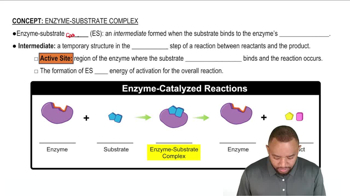
Active Site

The active site is a specific region on an enzyme where substrate molecules bind and undergo a chemical reaction. It is typically a small pocket or groove on the enzyme's surface, formed by the unique arrangement of amino acids. The shape and chemical environment of the active site are crucial for its ability to catalyze reactions, as they determine the specificity and efficiency of the enzyme.
추천 영상:
가이드 코스
1:06
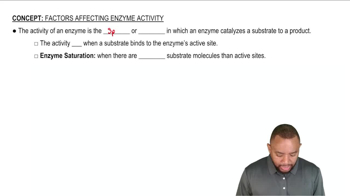
Factors Affecting Enzyme Activity Concept 1

Enzyme Structure

The overall structure of an enzyme refers to its three-dimensional shape, which is determined by the sequence of amino acids and the folding patterns that arise from interactions such as hydrogen bonds, ionic bonds, and hydrophobic interactions. This structure includes not only the active site but also other regions that contribute to the enzyme's stability and functionality. The complete enzyme structure is essential for maintaining the integrity and proper functioning of the active site.
추천 영상:
가이드 코스
2:14
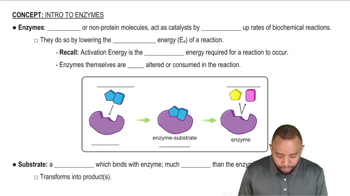
Intro to Enzymes Concept 1

Enzyme-Substrate Specificity

Enzyme-substrate specificity refers to the ability of an enzyme to selectively bind to a particular substrate, which is determined by the complementary shapes and chemical properties of the active site and the substrate. This specificity is often described by the 'lock and key' model or the 'induced fit' model, where the active site adjusts to fit the substrate upon binding. Understanding this concept is vital for grasping how enzymes catalyze specific biochemical reactions.
추천 영상:
가이드 코스
2:32
Enzyme-Substrate Complex Concept 1