Ch.16 Amino Acids, Proteins, and Enzymes
Timberlake - Chemistry: An Introduction to General, Organic, and Biological Chemistry 14th Edition
Timberlake14th EditionChemistry: An Introduction to General, Organic, and Biological ChemistryISBN: 9781292472249당신이 사용하는 게 아니라요?교과서 변경
16장, 문제 6a

Draw the structure for each of the following amino acids at physiological pH:
a. lysine

검증된 단계별 안내
1
Understand that at physiological pH (approximately 7.4), amino acids exist in their zwitterionic form. This means the amino group (-NH2) is protonated to form -NH3⁺, and the carboxylic acid group (-COOH) is deprotonated to form -COO⁻.
Identify the structure of lysine. Lysine is an amino acid with a side chain containing a primary amine group (-NH2) attached to a four-carbon chain. Its general structure includes an alpha carbon bonded to an amino group, a carboxyl group, a hydrogen atom, and the side chain.
Modify the structure of lysine to reflect its zwitterionic form at physiological pH. The alpha amino group (-NH2) becomes -NH3⁺, and the alpha carboxyl group (-COOH) becomes -COO⁻.
Add the side chain of lysine to the structure. The side chain contains a terminal amino group (-NH2) that remains protonated as -NH3⁺ at physiological pH because it is a basic group.
Combine all components to draw the complete structure of lysine at physiological pH. Ensure the alpha carbon is central, with the amino group (-NH3⁺), carboxylate group (-COO⁻), hydrogen atom, and the side chain (with its terminal -NH3⁺ group) correctly attached.

비슷한 문제에 대한 검증된 영상 답변:

이 영상 해법은 위 문제에 도움이 된다고 튜터들이 추천한 것입니다.
영상 길이:
1m

주요 개념

질문에 올바르게 답하기 위해 반드시 이해해야 하는 핵심 개념들은 다음과 같습니다.

Amino Acid Structure

Amino acids are organic compounds that serve as the building blocks of proteins. Each amino acid consists of a central carbon atom (the alpha carbon) bonded to an amino group (-NH2), a carboxyl group (-COOH), a hydrogen atom, and a variable side chain (R group) that determines the specific properties of the amino acid.
추천 영상:
가이드 코스
3:03
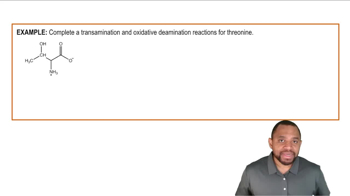
Amino Acid Catabolism: Amino Group Example 2

Physiological pH

Physiological pH refers to the pH level of human blood and other bodily fluids, which is typically around 7.4. At this pH, amino acids can exist in their zwitterionic form, where the amino group is protonated (-NH3+) and the carboxyl group is deprotonated (-COO-), affecting their overall charge and solubility.
추천 영상:
가이드 코스
02:09
pH and pOH Calculations

Lysine Properties

Lysine is a basic amino acid characterized by its positively charged side chain at physiological pH. Its side chain contains an additional amino group, which contributes to its basicity and makes lysine essential for protein synthesis, enzyme function, and various metabolic processes in the body.
추천 영상:
가이드 코스
02:11
Chemical Properties Example 1