Ch.17 Nucleic Acids and Protein Synthesis
Timberlake - Chemistry: An Introduction to General, Organic, and Biological Chemistry 14th Edition
Timberlake14th EditionChemistry: An Introduction to General, Organic, and Biological ChemistryISBN: 9781292472249당신이 사용하는 게 아니라요?교과서 변경
17장, 문제 25

How are the two strands of nucleic acid in DNA held together?

검증된 단계별 안내
1
Understand that DNA is composed of two strands forming a double helix structure. These strands are made up of nucleotides, which consist of a sugar, a phosphate group, and a nitrogenous base.
Recognize that the two strands of DNA are held together by hydrogen bonds between complementary nitrogenous bases. These bases are adenine (A), thymine (T), cytosine (C), and guanine (G).
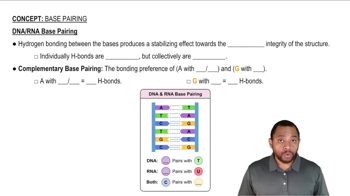
Learn the base-pairing rules: adenine (A) pairs with thymine (T) through two hydrogen bonds, and cytosine (C) pairs with guanine (G) through three hydrogen bonds.
Note that the hydrogen bonds are relatively weak individually, but collectively they provide stability to the DNA double helix while still allowing the strands to separate during processes like replication and transcription.
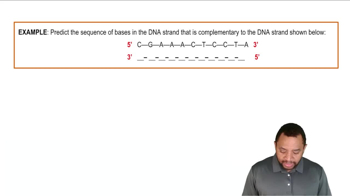
Understand that the strands are also oriented in opposite directions (antiparallel), with one strand running 5' to 3' and the other running 3' to 5', which is crucial for the structure and function of DNA.

비슷한 문제에 대한 검증된 영상 답변:

이 영상 해법은 위 문제에 도움이 된다고 튜터들이 추천한 것입니다.
영상 길이:
4m
도움이 되었나요?

주요 개념

질문에 올바르게 답하기 위해 반드시 이해해야 하는 핵심 개념들은 다음과 같습니다.

Base Pairing

Base pairing is a fundamental concept in molecular biology that describes how nucleotides in DNA connect to form the double helix structure. Adenine (A) pairs with thymine (T), and cytosine (C) pairs with guanine (G) through hydrogen bonds. This specific pairing ensures accurate replication and transcription of genetic information.
추천 영상:
가이드 코스
2:56
Base Pairing Concept 1

Hydrogen Bonds

Hydrogen bonds are weak interactions that occur between the hydrogen atom of one molecule and an electronegative atom of another. In DNA, these bonds form between the nitrogenous bases of the two strands, stabilizing the double helix structure. Although individually weak, the cumulative effect of many hydrogen bonds provides significant stability to the DNA molecule.
추천 영상:
가이드 코스
1:22
Hydrogenation Reactions Concept 1

Antiparallel Strands

The antiparallel nature of DNA refers to the orientation of the two strands that make up the double helix. One strand runs in a 5' to 3' direction, while the other runs 3' to 5'. This orientation is crucial for the mechanisms of DNA replication and transcription, as enzymes that interact with DNA recognize this directional arrangement.
추천 영상:
가이드 코스
1:49
DNA Double Helix Example 1