Ch.17 Nucleic Acids and Protein Synthesis
Timberlake - Chemistry: An Introduction to General, Organic, and Biological Chemistry 14th Edition
Timberlake14th EditionChemistry: An Introduction to General, Organic, and Biological ChemistryISBN: 9781292472249당신이 사용하는 게 아니라요?교과서 변경
17장, 문제 27d

Write the base sequence in a complementary DNA segment if each original segment has the following base sequence:
d. C T G T A T A C G T T A

검증된 단계별 안내
1
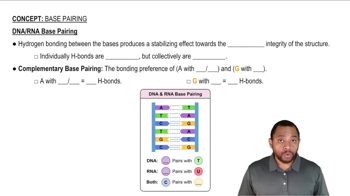
Step 1: Understand the concept of complementary base pairing in DNA. In DNA, adenine (A) pairs with thymine (T), and cytosine (C) pairs with guanine (G). This is due to the specific hydrogen bonding between these bases.
Step 2: Write down the original DNA sequence provided: C T G T A T A C G T T A.
Step 3: For each base in the original sequence, determine its complementary base using the base pairing rules: C pairs with G, T pairs with A, G pairs with C, and A pairs with T.
Step 4: Replace each base in the original sequence with its complementary base to construct the complementary DNA strand. For example, the first base 'C' in the original sequence will be replaced with 'G' in the complementary strand.
Step 5: Write the final complementary DNA sequence by combining all the complementary bases in the correct order.

비슷한 문제에 대한 검증된 영상 답변:

이 영상 해법은 위 문제에 도움이 된다고 튜터들이 추천한 것입니다.
영상 길이:
3m
도움이 되었나요?

주요 개념

질문에 올바르게 답하기 위해 반드시 이해해야 하는 핵심 개념들은 다음과 같습니다.

DNA Base Pairing

DNA base pairing is the principle that describes how nucleotides in a DNA strand pair with complementary nucleotides in another strand. Adenine (A) pairs with Thymine (T), and Cytosine (C) pairs with Guanine (G). This complementary nature is crucial for DNA replication and transcription, ensuring genetic information is accurately copied and expressed.
추천 영상:
가이드 코스
2:56
Base Pairing Concept 1

Complementary DNA Strand

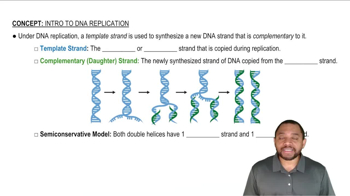
A complementary DNA strand is formed by pairing each nucleotide of the original DNA sequence with its corresponding partner. For example, if the original strand has a Cytosine (C), the complementary strand will have a Guanine (G). Understanding how to derive the complementary sequence is essential for tasks such as DNA replication and genetic analysis.
추천 영상:
가이드 코스
2:20
Intro to DNA Replication Concept 1

5' to 3' Directionality

DNA strands have directionality, indicated as 5' to 3'. This refers to the orientation of the sugar-phosphate backbone, where the 5' end has a phosphate group and the 3' end has a hydroxyl group. When writing complementary sequences, it is important to maintain this directionality, as DNA polymerases synthesize new strands in the 5' to 3' direction.
추천 영상:
가이드 코스
1:18
Drawing & Naming Peptides Concept 2