Ch.17 Nucleic Acids and Protein Synthesis
Timberlake - Chemistry: An Introduction to General, Organic, and Biological Chemistry 14th Edition
Timberlake14th EditionChemistry: An Introduction to General, Organic, and Biological ChemistryISBN: 9781292472249당신이 사용하는 게 아니라요?교과서 변경
17장, 문제 46

The codons UGA, UAA, and UAG do not code for amino acids. What is their role as codons in mRNA?

검증된 단계별 안내
1
Understand that codons are sequences of three nucleotides in mRNA that correspond to specific amino acids or signals during protein synthesis.
Recognize that UGA, UAA, and UAG are special codons known as 'stop codons' in the genetic code.
Explain that stop codons do not code for any amino acids. Instead, they signal the termination of translation, the process by which ribosomes synthesize proteins.
When a ribosome encounters a stop codon in the mRNA sequence, it releases the newly synthesized polypeptide chain, effectively ending protein synthesis.
Conclude that the role of UGA, UAA, and UAG is to act as termination signals, ensuring that proteins are synthesized to the correct length as dictated by the mRNA sequence.

비슷한 문제에 대한 검증된 영상 답변:

이 영상 해법은 위 문제에 도움이 된다고 튜터들이 추천한 것입니다.
영상 길이:
1m
도움이 되었나요?

주요 개념

질문에 올바르게 답하기 위해 반드시 이해해야 하는 핵심 개념들은 다음과 같습니다.

Stop Codons

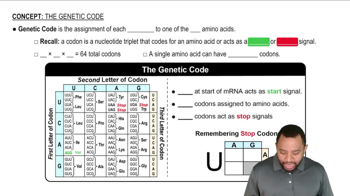
Stop codons are specific sequences in mRNA that signal the termination of protein synthesis. The codons UGA, UAA, and UAG are classified as stop codons because they do not correspond to any amino acids. Instead, they instruct the ribosome to halt translation, ensuring that the protein is completed correctly.
추천 영상:
가이드 코스
03:25
The Genetic Code Concept 1

Translation Process

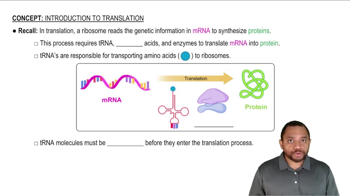
Translation is the process by which ribosomes synthesize proteins using mRNA as a template. During translation, ribosomes read the sequence of codons in mRNA and assemble the corresponding amino acids into a polypeptide chain. Stop codons play a crucial role in this process by indicating when the ribosome should stop adding amino acids.
추천 영상:
가이드 코스
1:42
Introduction to Translation Concept 1

Genetic Code

The genetic code is a set of rules that defines how sequences of nucleotides in mRNA are translated into amino acids. It consists of 64 codons, including 61 that code for amino acids and 3 that serve as stop signals. Understanding the genetic code is essential for interpreting how genes are expressed and how proteins are synthesized.
추천 영상:
가이드 코스
03:25
The Genetic Code Concept 1