Ch.17 Nucleic Acids and Protein Synthesis
Timberlake - Chemistry: An Introduction to General, Organic, and Biological Chemistry 14th Edition
Timberlake14th EditionChemistry: An Introduction to General, Organic, and Biological ChemistryISBN: 9781292472249당신이 사용하는 게 아니라요?교과서 변경
17장, 문제 48

Why are there at least 20 different tRNAs?

검증된 단계별 안내
1
Understand the role of tRNA: Transfer RNA (tRNA) is responsible for bringing the correct amino acid to the ribosome during protein synthesis. Each tRNA has an anticodon that pairs with a specific codon on the mRNA strand.
Recall the genetic code: The genetic code consists of 64 codons (triplets of nucleotides) that correspond to 20 standard amino acids. Some amino acids are encoded by more than one codon, a phenomenon known as codon redundancy or degeneracy.
Recognize the specificity of tRNA: Each tRNA molecule is specific to one amino acid and has an anticodon that matches the codon for that amino acid. This ensures accurate translation of the genetic code into a protein sequence.
Explain the need for at least 20 tRNAs: Since there are 20 standard amino acids, there must be at least 20 different tRNAs to ensure that each amino acid is properly matched to its corresponding codon during translation.
Consider wobble pairing: Some tRNAs can recognize multiple codons due to wobble base pairing at the third position of the codon. This reduces the total number of tRNAs needed, but there must still be at least 20 to account for all amino acids.

비슷한 문제에 대한 검증된 영상 답변:

이 영상 해법은 위 문제에 도움이 된다고 튜터들이 추천한 것입니다.
영상 길이:
51s
도움이 되었나요?

주요 개념

질문에 올바르게 답하기 위해 반드시 이해해야 하는 핵심 개념들은 다음과 같습니다.

tRNA Structure and Function

Transfer RNA (tRNA) is a type of RNA molecule that plays a crucial role in translating the genetic code into proteins. Each tRNA molecule has a specific structure that includes an anticodon region, which pairs with a corresponding codon on mRNA, and an amino acid attachment site. This structure allows tRNA to deliver the correct amino acid to the growing polypeptide chain during protein synthesis.
추천 영상:
가이드 코스
02:16
Logarithmic Functions

Genetic Code and Codons

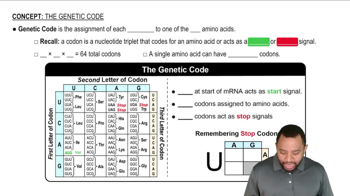
The genetic code consists of sequences of nucleotides in mRNA that are read in groups of three, known as codons. Each codon specifies a particular amino acid or a stop signal during protein synthesis. Since there are 64 possible codons (4 nucleotides raised to the power of 3), but only 20 standard amino acids, multiple codons can correspond to the same amino acid, necessitating a diverse set of tRNAs to ensure accurate translation.
추천 영상:
가이드 코스
03:25
The Genetic Code Concept 1

Wobble Hypothesis

The wobble hypothesis explains how some tRNAs can recognize more than one codon due to flexibility in base pairing at the third position of the codon. This allows for a reduced number of tRNA molecules while still accommodating the 64 codons. However, to maintain fidelity in protein synthesis and to account for all codons, at least 20 distinct tRNAs are required, each specific to one or more amino acids.
추천 영상:
가이드 코스
00:35
The Scientific Method Example 2