Ch.18 Metabolic Pathways and ATP Production
Timberlake - Chemistry: An Introduction to General, Organic, and Biological Chemistry 14th Edition
Timberlake14th EditionChemistry: An Introduction to General, Organic, and Biological ChemistryISBN: 9781292472249당신이 사용하는 게 아니라요?교과서 변경
18장, 문제 96c

Identify each of the following reactions a to e in the β oxidation of palmitic acid, a C16 fatty acid, as
(1) activation
(2) first oxidation
(3) hydration
(4) second oxidation
(5) cleavage
c. Palmitic acid, CoA, and ATP form palmitoyl CoA.

검증된 단계별 안내
1
Step 1: Understand the context of the problem. The β-oxidation of fatty acids is a metabolic process where fatty acids are broken down to generate acetyl-CoA, NADH, and FADH₂. The process involves several steps: activation, first oxidation, hydration, second oxidation, and cleavage.
Step 2: Analyze the given reaction. The problem states that palmitic acid, CoA (coenzyme A), and ATP form palmitoyl CoA. This indicates the initial step of preparing the fatty acid for β-oxidation.
Step 3: Recall the activation step. In the activation step, a fatty acid reacts with ATP and CoA to form an acyl-CoA (in this case, palmitoyl CoA). This step is catalyzed by the enzyme acyl-CoA synthetase and requires energy input from ATP.
Step 4: Match the reaction to the correct step in β-oxidation. Since the reaction involves the formation of palmitoyl CoA from palmitic acid, CoA, and ATP, it corresponds to the activation step of β-oxidation.
Step 5: Conclude that the reaction described (palmitic acid, CoA, and ATP forming palmitoyl CoA) is classified as the activation step in the β-oxidation of palmitic acid.

비슷한 문제에 대한 검증된 영상 답변:

이 영상 해법은 위 문제에 도움이 된다고 튜터들이 추천한 것입니다.
영상 길이:
1m

주요 개념

질문에 올바르게 답하기 위해 반드시 이해해야 하는 핵심 개념들은 다음과 같습니다.

β-Oxidation

β-Oxidation is a metabolic process that breaks down fatty acids into acetyl-CoA units, which can then enter the citric acid cycle for energy production. This process occurs in the mitochondria and involves a series of enzymatic reactions that sequentially remove two-carbon units from the fatty acid chain.

Activation of Fatty Acids

The activation of fatty acids is the first step in β-oxidation, where fatty acids are converted into acyl-CoA derivatives. This reaction is catalyzed by the enzyme acyl-CoA synthetase and requires ATP, which is hydrolyzed to AMP and pyrophosphate, making the fatty acid ready for subsequent oxidation.
추천 영상:
가이드 코스
2:00
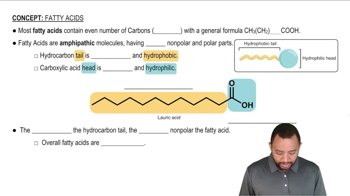
Fatty Acids Concept 1

Enzymatic Reactions in β-Oxidation

The β-oxidation pathway consists of four main enzymatic reactions: oxidation, hydration, a second oxidation, and cleavage. Each of these steps is crucial for the systematic breakdown of fatty acids, with specific enzymes facilitating the conversion of acyl-CoA to acetyl-CoA, ultimately releasing energy stored in the fatty acid.
추천 영상:
가이드 코스
1:32
Alcohol Reactions Oxidation Reactions Example 1