Ch.3 Matter and Energy
Timberlake - Chemistry: An Introduction to General, Organic, and Biological Chemistry 14th Edition
Timberlake14th EditionChemistry: An Introduction to General, Organic, and Biological ChemistryISBN: 9781292472249당신이 사용하는 게 아니라요?교과서 변경
3장, 문제 8b

Indicate whether each of the following describes a gas, a liquid, or a solid:
b. The particles in a tank of oxygen are very far apart.

검증된 단계별 안내
1
Step 1: Understand the three states of matter: solids, liquids, and gases. Solids have particles that are tightly packed in a fixed arrangement, liquids have particles that are close together but can move past one another, and gases have particles that are very far apart and move freely.
Step 2: Analyze the description provided in the problem. It states that the particles in the tank of oxygen are 'very far apart.'
Step 3: Recall that particles being 'very far apart' is a characteristic of the gas state, as gases have no fixed shape or volume and their particles are widely spaced.
Step 4: Conclude that the description matches the properties of a gas, as the particles in a gas are far apart and move independently.
Step 5: Verify your understanding by comparing this description to the properties of solids and liquids, which do not match the given scenario.

비슷한 문제에 대한 검증된 영상 답변:

이 영상 해법은 위 문제에 도움이 된다고 튜터들이 추천한 것입니다.
영상 길이:
2m
도움이 되었나요?

주요 개념

질문에 올바르게 답하기 위해 반드시 이해해야 하는 핵심 개념들은 다음과 같습니다.

States of Matter

Matter exists in three primary states: solid, liquid, and gas. Each state is characterized by the arrangement and behavior of its particles. In solids, particles are closely packed and vibrate in place; in liquids, they are close but can move past one another; in gases, particles are far apart and move freely.
추천 영상:
가이드 코스
01:35
States of Matter Concept 1

Particle Arrangement

The arrangement of particles in a substance determines its state. In gases, particles are widely spaced, allowing them to fill the container they occupy. This contrasts with liquids, where particles are closer together but still mobile, and solids, where particles are tightly packed and fixed in position.
추천 영상:
가이드 코스
03:51
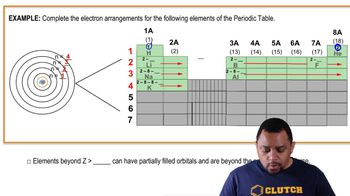
Electron Arrangements Example 1

Kinetic Molecular Theory

The Kinetic Molecular Theory explains the behavior of particles in different states of matter. It posits that gas particles are in constant, random motion and that their energy increases with temperature. This theory helps to understand why gases have low density and can expand to fill their containers, as seen in the example of oxygen in a tank.
추천 영상:
가이드 코스
01:19
Kinetic Molecular Theory Concept 1