Ch.3 Matter and Energy
Timberlake - Chemistry: An Introduction to General, Organic, and Biological Chemistry 14th Edition
Timberlake14th EditionChemistry: An Introduction to General, Organic, and Biological ChemistryISBN: 9781292472249당신이 사용하는 게 아니라요?교과서 변경
3장, 문제 8c

Indicate whether each of the following describes a gas, a liquid, or a solid:
c. Helium occupies the entire volume of a balloon.

검증된 단계별 안내
1
Step 1: Understand the properties of gases, liquids, and solids. Gases have no fixed shape or volume and expand to fill the container they are in. Liquids have a fixed volume but take the shape of their container. Solids have both a fixed shape and volume.
Step 2: Analyze the behavior of helium in the given scenario. The problem states that helium occupies the entire volume of a balloon.
Step 3: Relate this behavior to the properties of gases. A substance that expands to fill the entire volume of its container (in this case, the balloon) is characteristic of a gas.
Step 4: Conclude that helium in this scenario is behaving as a gas because it conforms to the property of gases by occupying the entire volume of the balloon.
Step 5: Verify your understanding by comparing this behavior to the properties of liquids and solids, which do not expand to fill the entire volume of their container.

비슷한 문제에 대한 검증된 영상 답변:

이 영상 해법은 위 문제에 도움이 된다고 튜터들이 추천한 것입니다.
영상 길이:
1m
도움이 되었나요?

주요 개념

질문에 올바르게 답하기 위해 반드시 이해해야 하는 핵심 개념들은 다음과 같습니다.

States of Matter

Matter exists in three primary states: solid, liquid, and gas. Solids have a fixed shape and volume, liquids have a fixed volume but take the shape of their container, and gases neither have a fixed shape nor a fixed volume, expanding to fill their container completely.
추천 영상:
가이드 코스
01:35
States of Matter Concept 1

Properties of Gases

Gases are characterized by their ability to expand and fill the volume of their container. This is due to the high kinetic energy of gas molecules, which allows them to move freely and spread out, resulting in low density and compressibility compared to solids and liquids.
추천 영상:
가이드 코스
04:22
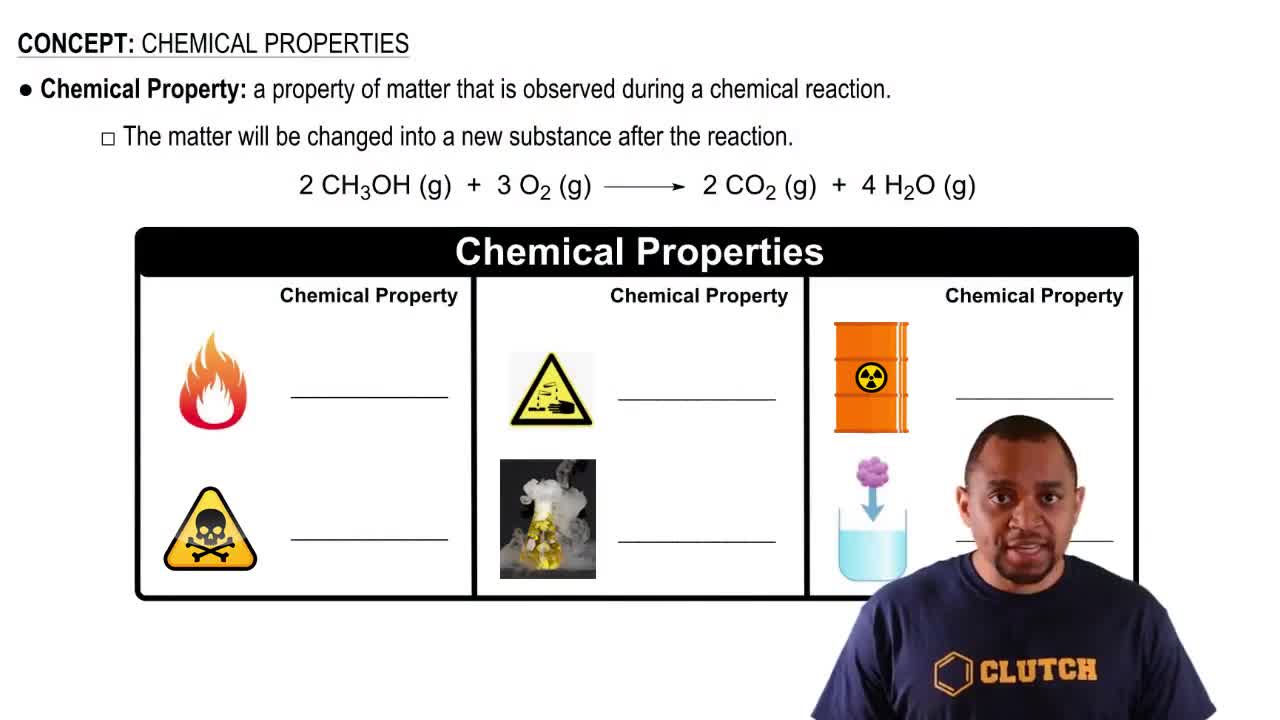
Chemical Properties Concept

Kinetic Molecular Theory

The Kinetic Molecular Theory explains the behavior of gases based on the motion of their particles. It posits that gas particles are in constant, random motion and that the temperature of a gas is directly related to the average kinetic energy of its particles, influencing how gases occupy space.
추천 영상:
가이드 코스
01:19
Kinetic Molecular Theory Concept 1