Ch.6 Ionic and Molecular Compounds
Timberlake - Chemistry: An Introduction to General, Organic, and Biological Chemistry 14th Edition
Timberlake14th EditionChemistry: An Introduction to General, Organic, and Biological ChemistryISBN: 9781292472249당신이 사용하는 게 아니라요?교과서 변경
6장, 문제 69b

For each of the following bonds, indicate the positive end with 𝛿⁺ and the negative end with 𝛿⁻ . Draw an arrow to show the dipole for each.
a. N and F

검증된 단계별 안내
1
Step 1: Understand the concept of electronegativity. Electronegativity is the ability of an atom to attract shared electrons in a chemical bond. The greater the difference in electronegativity between two atoms, the more polar the bond will be.
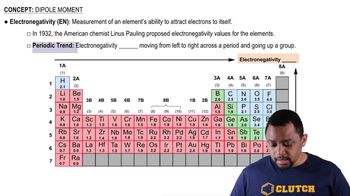
Step 2: Look up the electronegativity values of nitrogen (N) and fluorine (F). Fluorine has an electronegativity of approximately 3.98, while nitrogen has an electronegativity of approximately 3.04.
Step 3: Determine the direction of the dipole. Since fluorine has a higher electronegativity than nitrogen, it will attract the shared electrons more strongly, making fluorine the negative end (𝛿⁻) and nitrogen the positive end (𝛿⁺).
Step 4: Represent the dipole with an arrow. Draw an arrow pointing from the less electronegative atom (N) to the more electronegative atom (F). Place a small plus sign (+) at the tail of the arrow near nitrogen to indicate the positive end.
Step 5: Label the bond. Clearly mark the nitrogen atom with 𝛿⁺ and the fluorine atom with 𝛿⁻ to indicate the partial charges due to the unequal sharing of electrons.

비슷한 문제에 대한 검증된 영상 답변:

이 영상 해법은 위 문제에 도움이 된다고 튜터들이 추천한 것입니다.
영상 길이:
2m
도움이 되었나요?

주요 개념

질문에 올바르게 답하기 위해 반드시 이해해야 하는 핵심 개념들은 다음과 같습니다.

Electronegativity

Electronegativity is a measure of an atom's ability to attract and hold onto electrons in a chemical bond. In the context of the bond between nitrogen (N) and fluorine (F), fluorine is more electronegative than nitrogen, meaning it pulls the shared electrons closer to itself, creating a dipole moment.
추천 영상:
가이드 코스
01:51
Dipole Moment (Simplified) Concept 1

Dipole Moment

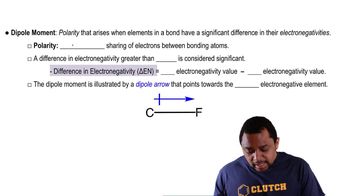
A dipole moment occurs in a polar bond where there is an uneven distribution of electron density. It is represented by an arrow pointing from the positive end (𝛿⁺) to the negative end (𝛿⁻) of the bond. In the N-F bond, the dipole moment indicates that the electrons are more concentrated around fluorine, making it the negative end.
추천 영상:
가이드 코스
01:25
Dipole Moment (Simplified) Concept 2

Polar vs. Nonpolar Bonds

Bonds can be classified as polar or nonpolar based on the difference in electronegativity between the two atoms involved. A polar bond, like that between N and F, has a significant difference in electronegativity, resulting in a dipole moment. In contrast, nonpolar bonds occur between atoms with similar electronegativities, leading to an even distribution of electron density.
추천 영상:
가이드 코스
01:34
Molecular Polarity (Simplified) Concept 1