Ch.6 Ionic and Molecular Compounds
Timberlake - Chemistry: An Introduction to General, Organic, and Biological Chemistry 14th Edition
Timberlake14th EditionChemistry: An Introduction to General, Organic, and Biological ChemistryISBN: 9781292472249당신이 사용하는 게 아니라요?교과서 변경
6장, 문제 65

Which electronegativity difference (a, b, or c) would you expect for a nonpolar covalent bond?
a. from 0.0 to 0.4
b. from 0.5 to 1.8
c. from 1.9 to 3.3

검증된 단계별 안내
1
Step 1: Recall the definition of a nonpolar covalent bond. A nonpolar covalent bond occurs when two atoms share electrons equally, which happens when the electronegativity difference between the two atoms is very small or zero.
Step 2: Understand the role of electronegativity difference. Electronegativity is a measure of an atom's ability to attract shared electrons in a bond. A small difference in electronegativity (close to 0) indicates equal sharing of electrons, characteristic of a nonpolar covalent bond.
Step 3: Analyze the given ranges of electronegativity differences: (a) 0.0 to 0.4, (b) 0.5 to 1.8, and (c) 1.9 to 3.3. Note that as the difference increases, the bond becomes more polar, and eventually ionic if the difference is very large.
Step 4: Identify the range that corresponds to a nonpolar covalent bond. Since nonpolar covalent bonds have an electronegativity difference close to 0, the range 0.0 to 0.4 (option a) is the most appropriate.
Step 5: Conclude that the electronegativity difference for a nonpolar covalent bond is expected to fall within the range of 0.0 to 0.4, as this indicates minimal or no polarity in the bond.

비슷한 문제에 대한 검증된 영상 답변:

이 영상 해법은 위 문제에 도움이 된다고 튜터들이 추천한 것입니다.
영상 길이:
1m
도움이 되었나요?

주요 개념

질문에 올바르게 답하기 위해 반드시 이해해야 하는 핵심 개념들은 다음과 같습니다.

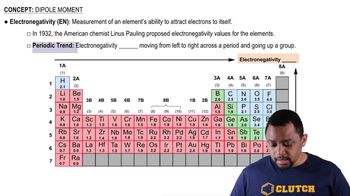
Electronegativity

Electronegativity is a measure of an atom's ability to attract and hold onto electrons in a chemical bond. It is a key factor in determining the nature of the bond formed between two atoms. The higher the electronegativity, the stronger the atom's pull on the shared electrons.
추천 영상:
가이드 코스
01:51
Dipole Moment (Simplified) Concept 1

Covalent Bonds

Covalent bonds are formed when two atoms share one or more pairs of electrons. The nature of the bond can vary based on the difference in electronegativity between the two atoms. Nonpolar covalent bonds occur when the electronegativity difference is minimal, leading to an equal sharing of electrons.
추천 영상:
가이드 코스
01:04
Covalent Bonds Example 1

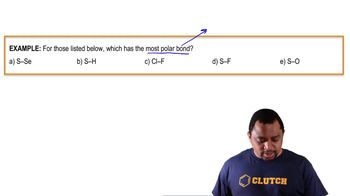
Electronegativity Difference

The electronegativity difference between two atoms determines the type of bond they will form. A difference of 0.0 to 0.4 typically indicates a nonpolar covalent bond, where electrons are shared equally. In contrast, larger differences suggest polar covalent or ionic bonds, where electron sharing is unequal.
추천 영상:
가이드 코스
01:07
Dipole Moment (Simplified) Example 3