Ch.7 Chemical Quantities and Reactions
Timberlake - Chemistry: An Introduction to General, Organic, and Biological Chemistry 14th Edition
Timberlake14th EditionChemistry: An Introduction to General, Organic, and Biological ChemistryISBN: 9781292472249당신이 사용하는 게 아니라요?교과서 변경
7장, 문제 73a

What is meant by the rate of a reaction?

검증된 단계별 안내
1
The rate of a reaction refers to how quickly or slowly a chemical reaction occurs. It is typically expressed as the change in concentration of a reactant or product per unit time.
To understand the rate, consider the formula: Rate=Ct, where C represents the concentration of a reactant or product, and t represents time.
Reaction rates can be influenced by several factors, including temperature, concentration of reactants, presence of a catalyst, and the physical state of the reactants.
The rate can be measured experimentally by monitoring changes in properties such as color, pressure, or mass that are related to the concentration of reactants or products.
Understanding reaction rates is crucial for controlling chemical processes in industrial applications, biological systems, and laboratory experiments.

비슷한 문제에 대한 검증된 영상 답변:

이 영상 해법은 위 문제에 도움이 된다고 튜터들이 추천한 것입니다.
영상 길이:
1m
도움이 되었나요?

주요 개념

질문에 올바르게 답하기 위해 반드시 이해해야 하는 핵심 개념들은 다음과 같습니다.

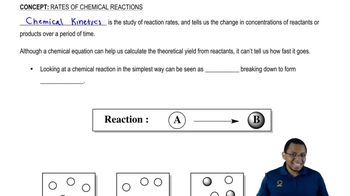
Rate of Reaction

The rate of a reaction refers to the speed at which reactants are converted into products in a chemical reaction. It is typically measured as the change in concentration of a reactant or product per unit time, often expressed in moles per liter per second (mol/L/s). Understanding the rate of reaction is crucial for predicting how quickly a reaction will occur under various conditions.
추천 영상:
가이드 코스
01:07
Rate of Reaction Concept 1

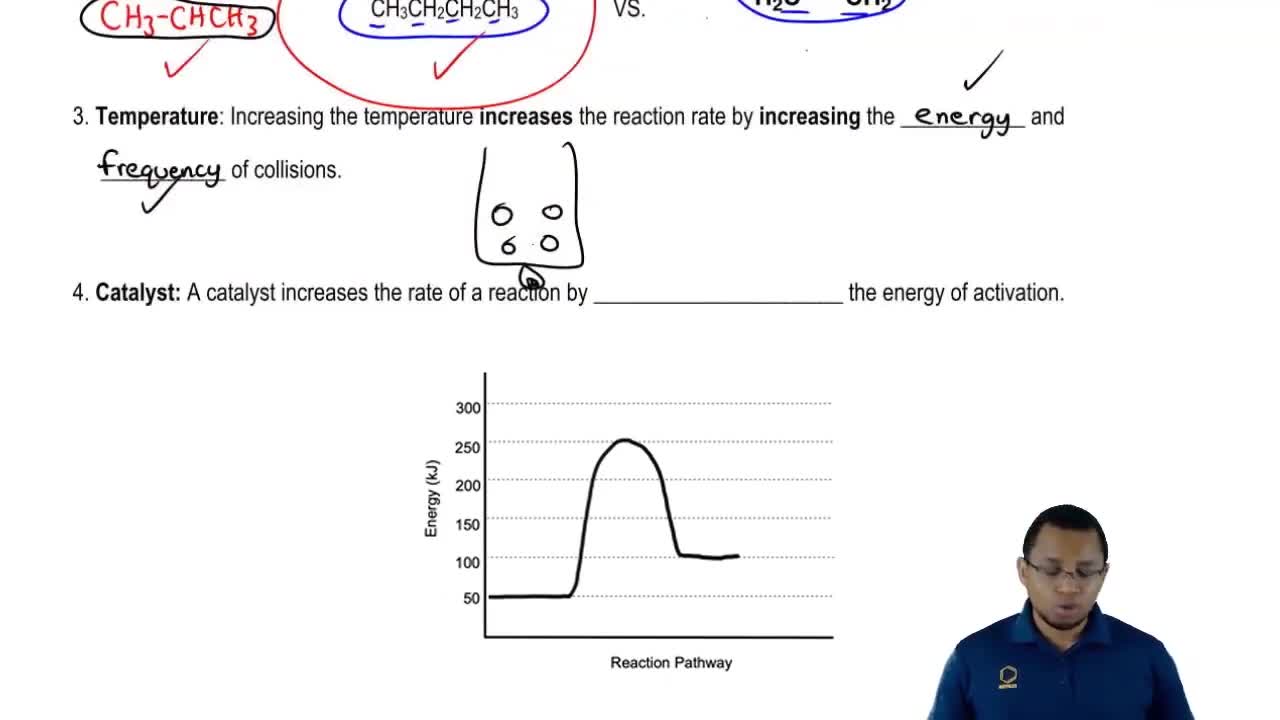
Factors Affecting Reaction Rate

Several factors influence the rate of a chemical reaction, including temperature, concentration of reactants, surface area, and the presence of catalysts. For instance, increasing the temperature generally increases the reaction rate by providing more energy to the molecules, leading to more frequent and effective collisions. Recognizing these factors helps in controlling and optimizing reactions in both laboratory and industrial settings.
추천 영상:
가이드 코스
02:16
Rate of Reaction Concept 7

Reaction Mechanism

The reaction mechanism is the step-by-step sequence of elementary reactions by which overall chemical change occurs. Understanding the mechanism provides insight into how reactants transform into products and can reveal the rate-determining step, which is the slowest step that limits the overall reaction rate. This concept is essential for chemists to design more efficient reactions and predict outcomes.
추천 영상:
가이드 코스
1:30
Alcohol Reactions: Dehydration Reactions Concept 1