Ch.7 Chemical Quantities and Reactions
Timberlake - Chemistry: An Introduction to General, Organic, and Biological Chemistry 14th Edition
Timberlake14th EditionChemistry: An Introduction to General, Organic, and Biological ChemistryISBN: 9781292472249당신이 사용하는 게 아니라요?교과서 변경
7장, 문제 68a

What is measured by the heat of reaction?

검증된 단계별 안내
1
The heat of reaction, also known as enthalpy change (ΔH), measures the amount of heat energy absorbed or released during a chemical reaction at constant pressure.
If ΔH is negative, the reaction is exothermic, meaning it releases heat to the surroundings. Conversely, if ΔH is positive, the reaction is endothermic, meaning it absorbs heat from the surroundings.
The heat of reaction is typically expressed in units of energy, such as joules (J) or kilojoules (kJ), and is often reported per mole of a reactant or product.
To determine the heat of reaction experimentally, calorimetry is commonly used. This involves measuring the temperature change of a system and applying the formula: q = mcΔT, where q is the heat, m is the mass, c is the specific heat capacity, and ΔT is the temperature change.
In chemical equations, the heat of reaction is often written as part of the equation, such as: CH4 + 2O2CO2 + 2H2O + ΔH, where ΔH indicates the heat released or absorbed.

비슷한 문제에 대한 검증된 영상 답변:

이 영상 해법은 위 문제에 도움이 된다고 튜터들이 추천한 것입니다.
영상 길이:
2m

주요 개념

질문에 올바르게 답하기 위해 반드시 이해해야 하는 핵심 개념들은 다음과 같습니다.

Heat of Reaction

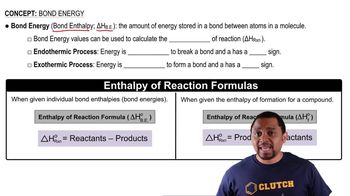
The heat of reaction, also known as enthalpy change, measures the amount of heat absorbed or released during a chemical reaction at constant pressure. It indicates whether a reaction is exothermic (releases heat) or endothermic (absorbs heat), providing insight into the energy dynamics of the reaction.
추천 영상:

Enthalpy

Enthalpy is a thermodynamic property that represents the total heat content of a system. It is defined as the sum of the internal energy and the product of pressure and volume. Changes in enthalpy during a reaction help determine the heat of reaction and are crucial for understanding energy transfer in chemical processes.
추천 영상:

Thermochemical Equations

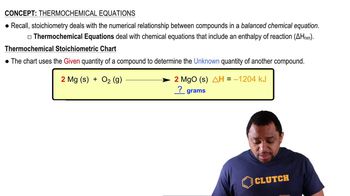
Thermochemical equations are balanced chemical equations that include the heat of reaction. They provide a quantitative measure of the energy change associated with a reaction, allowing chemists to predict how much heat will be released or absorbed under specific conditions, which is essential for practical applications in chemistry.
추천 영상:
가이드 코스
01:13
Thermochemical Equations