Ch.7 Chemical Quantities and Reactions
Timberlake - Chemistry: An Introduction to General, Organic, and Biological Chemistry 14th Edition
Timberlake14th EditionChemistry: An Introduction to General, Organic, and Biological ChemistryISBN: 9781292472249당신이 사용하는 게 아니라요?교과서 변경
7장, 문제 83

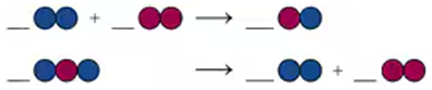
Balance each of the following by adding coefficients, and identify the type of reaction for each:
a.

검증된 단계별 안내
1
Step 1: Analyze the reactants and products in the image. The reactants include a red diatomic molecule (likely O₂), a blue single atom, and a purple diatomic molecule. The products consist of a red diatomic molecule, a blue single atom, and a purple diatomic molecule arranged in a different order.
Step 2: Write the unbalanced chemical equation based on the image. Represent the red diatomic molecule as R₂, the blue atom as B, and the purple diatomic molecule as P₂. The equation is: R₂ + B + P₂ → R₂ + B + P₂.
Step 3: Count the number of each type of atom on both sides of the equation. Ensure the number of red, blue, and purple atoms is equal on both sides.
Step 4: Add coefficients to balance the equation. Since the number of atoms is already equal on both sides, the equation is balanced as written: R₂ + B + P₂ → R₂ + B + P₂.
Step 5: Identify the type of reaction. This appears to be a rearrangement reaction, where the reactants are reorganized into the same products without any change in composition.

비슷한 문제에 대한 검증된 영상 답변:

이 영상 해법은 위 문제에 도움이 된다고 튜터들이 추천한 것입니다.
영상 길이:
2m

주요 개념

질문에 올바르게 답하기 위해 반드시 이해해야 하는 핵심 개념들은 다음과 같습니다.

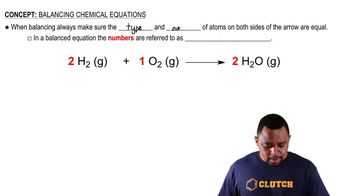
Balancing Chemical Equations

Balancing chemical equations involves ensuring that the number of atoms for each element is the same on both sides of the equation. This is achieved by adjusting coefficients in front of the chemical formulas. The law of conservation of mass dictates that matter cannot be created or destroyed in a chemical reaction, thus requiring balanced equations to accurately represent the reaction.
추천 영상:
가이드 코스
01:32
Balancing Chemical Equations (Simplified) Concept 1

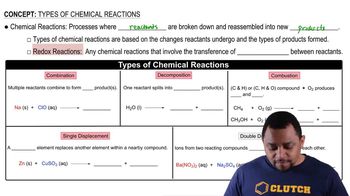
Types of Chemical Reactions

Chemical reactions can be classified into several types, including synthesis, decomposition, single replacement, and double replacement reactions. Each type has distinct characteristics; for example, synthesis reactions involve combining elements to form a compound, while decomposition reactions break down compounds into simpler substances. Identifying the type of reaction helps predict the products formed.
추천 영상:
가이드 코스
04:07
Types of Chemical Reactions Concept 1

Molecular Representation

Molecular representation uses symbols and diagrams to depict the arrangement of atoms in a molecule. In the provided image, colored spheres represent different atoms, illustrating how they combine during a reaction. Understanding molecular representation is crucial for visualizing chemical interactions and predicting the outcomes of reactions based on the types and numbers of atoms involved.
추천 영상:
가이드 코스
2:08
Molecular Representations Concept 1