Ch.7 Chemical Quantities and Reactions
Timberlake - Chemistry: An Introduction to General, Organic, and Biological Chemistry 14th Edition
Timberlake14th EditionChemistry: An Introduction to General, Organic, and Biological ChemistryISBN: 9781292472249당신이 사용하는 게 아니라요?교과서 변경
7장, 문제 80c

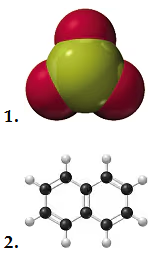
Using the models of the molecules (black = C, white = H, yellow = S, red = O), determine each of the following for models of compounds 1 and 2:

c. number of moles in 10.0 g

검증된 단계별 안내
1
Step 1: Identify the molecular formula for each compound based on the color-coded atoms in the models. For compound 1, the molecule consists of sulfur (yellow), oxygen (red), and hydrogen (white). For compound 2, the molecule includes carbon (black), hydrogen (white), and nitrogen (blue).
Step 2: Determine the molar mass of each compound by summing the atomic masses of all atoms in the molecular formula. Use the periodic table to find the atomic masses: Carbon (C) = 12.01 g/mol, Hydrogen (H) = 1.008 g/mol, Sulfur (S) = 32.07 g/mol, Oxygen (O) = 16.00 g/mol, and Nitrogen (N) = 14.01 g/mol.
Step 3: Calculate the number of moles in 10.0 g of each compound using the formula: \( \text{moles} = \frac{\text{mass}}{\text{molar mass}} \). Substitute the given mass (10.0 g) and the molar mass calculated in Step 2.
Step 4: Perform dimensional analysis to ensure the units cancel appropriately, leaving the result in moles. This step confirms the calculation is set up correctly.
Step 5: Interpret the results to understand the number of moles for each compound. This value represents the quantity of molecules present in 10.0 g of the substance.

비슷한 문제에 대한 검증된 영상 답변:

이 영상 해법은 위 문제에 도움이 된다고 튜터들이 추천한 것입니다.
영상 길이:
5m
도움이 되었나요?

주요 개념

질문에 올바르게 답하기 위해 반드시 이해해야 하는 핵심 개념들은 다음과 같습니다.

Molecular Composition

Molecular composition refers to the types and numbers of atoms present in a molecule. In the context of the question, understanding the molecular formulas of compounds 1 and 2 is essential for determining their properties and behaviors in chemical reactions. The colors in the models represent different elements: black for carbon (C), white for hydrogen (H), yellow for sulfur (S), and red for oxygen (O).
추천 영상:
가이드 코스
02:08
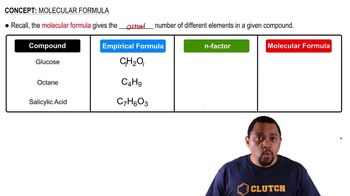
Molecular Formula

Moles and Molar Mass

A mole is a unit in chemistry that represents 6.022 x 10²³ particles (atoms, molecules, etc.). Molar mass is the mass of one mole of a substance, typically expressed in grams per mole (g/mol). To find the number of moles in a given mass (like 10.0 g), one must divide the mass by the molar mass of the compound. This concept is crucial for quantifying substances in chemical reactions.
추천 영상:
가이드 코스
01:10
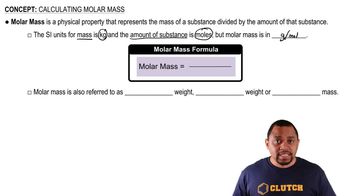
Calculating Molar Mass

Stoichiometry

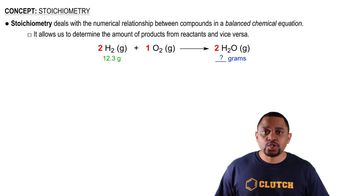
Stoichiometry is the calculation of reactants and products in chemical reactions. It involves using the balanced chemical equation to determine the relationships between the amounts of substances involved. In this question, stoichiometry will help in understanding how the number of moles of each compound relates to the overall reaction and how to calculate the moles from the given mass.
추천 영상: