Ch.7 Chemical Quantities and Reactions
Timberlake - Chemistry: An Introduction to General, Organic, and Biological Chemistry 14th Edition
Timberlake14th EditionChemistry: An Introduction to General, Organic, and Biological ChemistryISBN: 9781292472249당신이 사용하는 게 아니라요?교과서 변경
7장, 문제 86c

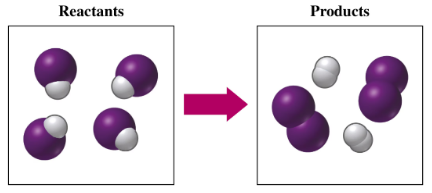
If purple spheres represent iodine atoms, white spheres represent hydrogen atoms, and all the molecules are gases,

c. indicate the type of reaction as combination, decomposition, single replacement, double replacement, or combustion.

검증된 단계별 안내
1
Step 1: Analyze the reactants and products in the image. The reactants consist of two types of molecules: one with a blue sphere bonded to an orange sphere and another with a single gray sphere. The products consist of two molecules: one with two blue spheres bonded together and another with two gray spheres bonded together.
Step 2: Identify the type of chemical reaction. In this case, the reactants are breaking apart and recombining to form new molecules. This indicates that bonds are being broken and new bonds are being formed.
Step 3: Determine the reaction type based on the changes observed. Since the reactants are breaking apart into simpler components and forming new molecules, this is characteristic of a decomposition reaction.
Step 4: Confirm the reaction type by considering the definition of decomposition reactions. A decomposition reaction involves a single compound breaking down into two or more simpler substances. In this case, the reactants are breaking apart and recombining into simpler molecules.
Step 5: Conclude that the reaction shown in the image is a decomposition reaction based on the analysis of the reactants and products.

비슷한 문제에 대한 검증된 영상 답변:

이 영상 해법은 위 문제에 도움이 된다고 튜터들이 추천한 것입니다.
영상 길이:
2m
도움이 되었나요?

주요 개념

질문에 올바르게 답하기 위해 반드시 이해해야 하는 핵심 개념들은 다음과 같습니다.

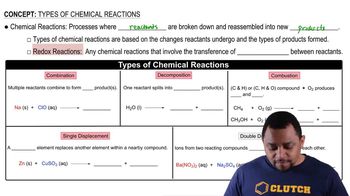
Types of Chemical Reactions

Chemical reactions can be classified into several types, including combination, decomposition, single replacement, double replacement, and combustion. Each type has distinct characteristics: combination reactions involve two or more reactants forming a single product, while decomposition reactions break down a compound into simpler substances. Understanding these classifications helps in predicting the products of a reaction based on the reactants involved.
추천 영상:
가이드 코스
04:07
Types of Chemical Reactions Concept 1

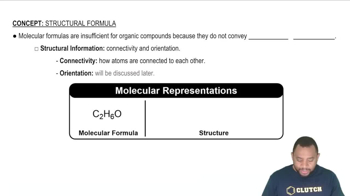
Molecular Representation

In chemical diagrams, different colored spheres often represent different types of atoms, such as purple for iodine and white for hydrogen. This visual representation aids in understanding the composition of molecules and how they interact during reactions. Recognizing these representations is crucial for analyzing the reactants and products in a chemical equation.
추천 영상:
가이드 코스
2:08
Molecular Representations Concept 1

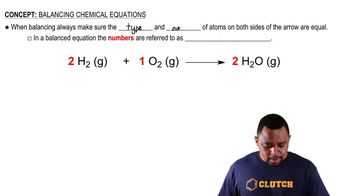
Balancing Chemical Equations

Balancing chemical equations is essential to ensure that the number of atoms of each element is conserved during a reaction. This involves adjusting coefficients in front of the chemical formulas to match the number of atoms on both sides of the equation. Properly balanced equations reflect the law of conservation of mass and are fundamental for accurately describing chemical reactions.
추천 영상:
가이드 코스
01:32
Balancing Chemical Equations (Simplified) Concept 1