Ch.7 Chemical Quantities and Reactions
Timberlake - Chemistry: An Introduction to General, Organic, and Biological Chemistry 14th Edition
Timberlake14th EditionChemistry: An Introduction to General, Organic, and Biological ChemistryISBN: 9781292472249당신이 사용하는 게 아니라요?교과서 변경
7장, 문제 106a

Propane gas, C3H8, undergoes combustion with oxygen gas to produce carbon dioxide and water gases. Propane has a density of 2.02 g/L at room temperature.
a. Write the balanced chemical equation.

검증된 단계별 안내
1
Step 1: Write the unbalanced chemical equation for the combustion of propane. Combustion reactions involve a hydrocarbon reacting with oxygen gas (O₂) to produce carbon dioxide (CO₂) and water (H₂O). The unbalanced equation is: C₃H₈ + O₂ → CO₂ + H₂O.
Step 2: Balance the carbon (C) atoms. Propane (C₃H₈) contains 3 carbon atoms, so you need 3 CO₂ molecules on the product side. The equation becomes: C₃H₈ + O₂ → 3CO₂ + H₂O.
Step 3: Balance the hydrogen (H) atoms. Propane contains 8 hydrogen atoms, so you need 4 H₂O molecules on the product side to balance the hydrogen. The equation now looks like: C₃H₈ + O₂ → 3CO₂ + 4H₂O.
Step 4: Balance the oxygen (O) atoms. On the product side, there are 3 CO₂ molecules (3 × 2 = 6 oxygen atoms) and 4 H₂O molecules (4 × 1 = 4 oxygen atoms), for a total of 10 oxygen atoms. On the reactant side, O₂ is diatomic, so you need 5 O₂ molecules to provide 10 oxygen atoms. The balanced equation becomes: C₃H₈ + 5O₂ → 3CO₂ + 4H₂O.
Step 5: Verify the balance. Check that the number of each type of atom is the same on both sides of the equation. There are 3 carbon atoms, 8 hydrogen atoms, and 10 oxygen atoms on both sides, confirming the equation is balanced.

비슷한 문제에 대한 검증된 영상 답변:

이 영상 해법은 위 문제에 도움이 된다고 튜터들이 추천한 것입니다.
영상 길이:
3m
도움이 되었나요?

주요 개념

질문에 올바르게 답하기 위해 반드시 이해해야 하는 핵심 개념들은 다음과 같습니다.

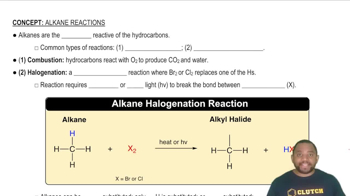
Combustion Reaction

A combustion reaction is a chemical process in which a substance reacts rapidly with oxygen, producing heat and light. In the case of propane (C₃H₈), it combusts in the presence of oxygen (O₂) to yield carbon dioxide (CO₂) and water (H₂O). This type of reaction is essential in understanding energy production in fuels.
추천 영상:
가이드 코스
2:25
Common Types of Alkane Reactions Concept 1

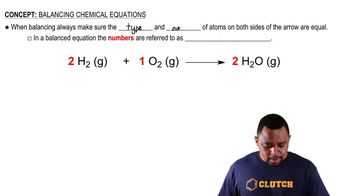
Balancing Chemical Equations

Balancing chemical equations involves ensuring that the number of atoms for each element is the same on both sides of the equation. This is crucial for obeying the law of conservation of mass, which states that matter cannot be created or destroyed in a chemical reaction. Proper balancing allows for accurate stoichiometric calculations.
추천 영상:
가이드 코스
01:32
Balancing Chemical Equations (Simplified) Concept 1

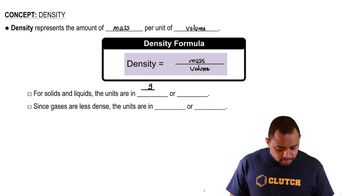
Molar Volume and Density

Density is defined as mass per unit volume and is a key property in determining how substances behave in reactions. For gases, the molar volume at standard temperature and pressure (STP) is approximately 22.4 L/mol. Understanding the density of propane (2.02 g/L) helps in calculating the amount of propane available for combustion and its stoichiometric relationships.
추천 영상: