
Ch.8 Gases
Timberlake - Chemistry: An Introduction to General, Organic, and Biological Chemistry 14th Edition
Timberlake14th EditionChemistry: An Introduction to General, Organic, and Biological ChemistryISBN: 9781292472249당신이 사용하는 게 아니라요?교과서 변경
8장, 문제 31

A gas sample has a volume of 0.256 L with an unknown temperature. The same gas has a volume of 0.198 L when the temperature is 32 °C, with no change in the pressure or amount of gas. What was the initial temperature, in degrees Celsius, of the gas?

검증된 단계별 안내
1
Step 1: Recognize that this problem involves Charles's Law, which states that the volume of a gas is directly proportional to its temperature in Kelvin when pressure and the amount of gas are constant. The formula for Charles's Law is: VT=VT, where V is volume and T is temperature in Kelvin.
Step 2: Convert the given temperature of 32 °C to Kelvin using the formula: T=T+273.15. This ensures all temperatures are in Kelvin, as required by Charles's Law.
Step 3: Rearrange Charles's Law to solve for the initial temperature (T₁): T1=V1×T2V2, where V₁ is the initial volume, V₂ is the final volume, and T₂ is the final temperature in Kelvin.
Step 4: Substitute the known values into the rearranged formula. Use V₁ = 0.256 L, V₂ = 0.198 L, and T₂ (converted to Kelvin from Step 2). Ensure all units are consistent.
Step 5: After calculating the initial temperature in Kelvin, convert it back to degrees Celsius using the formula: T=T-273.15. This will give the initial temperature in °C.

비슷한 문제에 대한 검증된 영상 답변:

이 영상 해법은 위 문제에 도움이 된다고 튜터들이 추천한 것입니다.
영상 길이:
3m
도움이 되었나요?

주요 개념

질문에 올바르게 답하기 위해 반드시 이해해야 하는 핵심 개념들은 다음과 같습니다.

Charles's Law

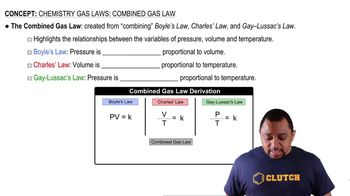
Charles's Law states that the volume of a gas is directly proportional to its temperature (in Kelvin) when pressure and the amount of gas are held constant. This relationship can be expressed mathematically as V1/T1 = V2/T2, where V is volume and T is temperature. Understanding this law is crucial for solving problems involving gas behavior under varying temperatures.
추천 영상:
가이드 코스
01:43
Chemistry Gas Laws: Combined Gas Law

Absolute Temperature

Absolute temperature is measured in Kelvin and is essential for gas law calculations. It is derived from the Celsius scale by adding 273.15 to the Celsius temperature. Since gas laws require temperatures in Kelvin to maintain proportional relationships, converting Celsius to Kelvin is a necessary step in solving gas-related problems.
추천 영상:
가이드 코스
01:30
Temperature (Simplified) Concept 1

Gas Volume and Temperature Relationship

The relationship between gas volume and temperature is fundamental in thermodynamics. As the temperature of a gas increases, its volume tends to increase if pressure remains constant. This concept is pivotal in predicting how changes in temperature affect the volume of a gas, allowing for the calculation of unknown temperatures when given specific volume measurements.
추천 영상:
가이드 코스
04:56
Logarithmic Relationships