Ch.8 Gases
Timberlake - Chemistry: An Introduction to General, Organic, and Biological Chemistry 14th Edition
Timberlake14th EditionChemistry: An Introduction to General, Organic, and Biological ChemistryISBN: 9781292472249당신이 사용하는 게 아니라요?교과서 변경
8장, 문제 77b

A weather balloon is partially filled with helium to allow for expansion at high altitudes. At STP, a weather balloon is filled with enough helium to give a volume of 25.0 L. At an altitude of 30.0 km and –35 ⁰C, it has expanded to 2460 L. The increase in volume causes it to burst and a small parachute returns the instruments to Earth.
b. What is the final pressure, in millimeters of mercury, of the helium inside the balloon when it bursts?

검증된 단계별 안내
1
Identify the given values and the unknown: The problem provides the initial conditions (STP: standard temperature and pressure, 0 °C or 273.15 K, and 1 atm or 760 mmHg), the initial volume (25.0 L), the final volume (2460 L), and the final temperature (―35 °C or 238.15 K). The unknown is the final pressure in mmHg.
Use the combined gas law to relate the initial and final states of the gas. The combined gas law is: P1V1T1=P2V2T2, where P is pressure, V is volume, and T is temperature.
Rearrange the combined gas law to solve for the final pressure, P2: P2=P1V1T2V2T1.
Substitute the known values into the equation. Use P1=760 mmHg, V1=25.0 L, T1=273.15 K, V2=2460 L, and T2=238.15 K.
Perform the calculations step by step to determine the final pressure, P2, in mmHg. Ensure that the units are consistent throughout the calculation and that the final answer is expressed in mmHg.

비슷한 문제에 대한 검증된 영상 답변:

이 영상 해법은 위 문제에 도움이 된다고 튜터들이 추천한 것입니다.
영상 길이:
6m

주요 개념

질문에 올바르게 답하기 위해 반드시 이해해야 하는 핵심 개념들은 다음과 같습니다.

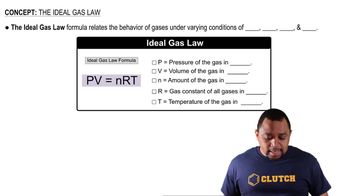
Ideal Gas Law

The Ideal Gas Law is a fundamental equation in chemistry that relates the pressure, volume, temperature, and number of moles of a gas. It is expressed as PV = nRT, where P is pressure, V is volume, n is the number of moles, R is the ideal gas constant, and T is temperature in Kelvin. This law is essential for understanding how gases behave under varying conditions, such as changes in volume and temperature, which is crucial for solving the problem of the weather balloon.
추천 영상:
가이드 코스
01:15
The Ideal Gas Law Concept 1

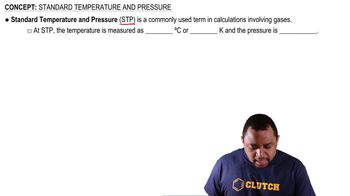
Standard Temperature and Pressure (STP)

Standard Temperature and Pressure (STP) is a reference point used in gas calculations, defined as 0 degrees Celsius (273.15 K) and 1 atmosphere (101.3 kPa) of pressure. At STP, the behavior of gases can be predicted more easily, allowing for comparisons and calculations. Understanding STP is important for determining the initial conditions of the helium in the weather balloon before it ascends to higher altitudes.
추천 영상:
가이드 코스
00:33
Standard Temperature and Pressure Concept 1

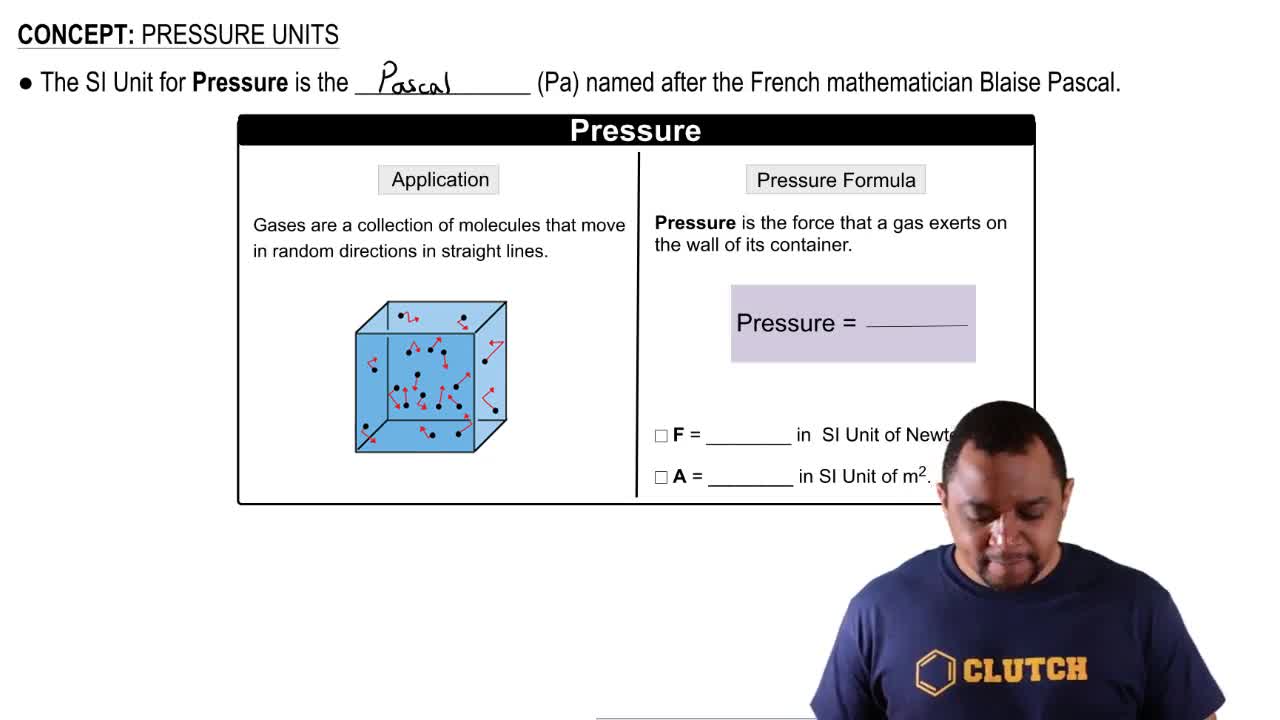
Gas Expansion and Pressure Changes

As a gas expands, its pressure decreases if the temperature remains constant, according to Boyle's Law. In the context of the weather balloon, as it ascends to higher altitudes, the decrease in external pressure allows the helium to expand significantly. This concept is critical for calculating the final pressure of the gas inside the balloon when it bursts, as it directly relates to the volume change and the temperature at that altitude.
추천 영상:
가이드 코스
01:15
Pressure Units Concept 1