Ch.8 Gases
Timberlake - Chemistry: An Introduction to General, Organic, and Biological Chemistry 14th Edition
Timberlake14th EditionChemistry: An Introduction to General, Organic, and Biological ChemistryISBN: 9781292472249당신이 사용하는 게 아니라요?교과서 변경
8장, 문제 71

In 1783, Jacques Charles launched his first balloon filled with hydrogen gas, which he chose because it was lighter than air. If the balloon had a volume of 31 000 L, how many kilograms of hydrogen were needed to fill the balloon at STP?
<IMAGE>

검증된 단계별 안내
1
Step 1: Recall the conditions of STP (Standard Temperature and Pressure). At STP, the temperature is 273.15 K, the pressure is 1 atm, and 1 mole of any ideal gas occupies 22.4 L.
Step 2: Use the volume of the balloon (31,000 L) and the molar volume of a gas at STP (22.4 L/mol) to calculate the number of moles of hydrogen gas. The formula is: \( \text{moles of H}_2 = \frac{\text{volume of H}_2}{\text{molar volume at STP}} \).
Step 3: Determine the molar mass of hydrogen gas (H₂). Since each hydrogen atom has a molar mass of approximately 1.008 g/mol, the molar mass of H₂ is \( 2 \times 1.008 = 2.016 \ \text{g/mol} \).
Step 4: Convert the moles of hydrogen gas to grams using the formula: \( \text{mass of H}_2 = \text{moles of H}_2 \times \text{molar mass of H}_2 \).
Step 5: Convert the mass of hydrogen gas from grams to kilograms by dividing by 1,000. The formula is: \( \text{mass in kg} = \frac{\text{mass in g}}{1000} \).

비슷한 문제에 대한 검증된 영상 답변:

이 영상 해법은 위 문제에 도움이 된다고 튜터들이 추천한 것입니다.
영상 길이:
2m
도움이 되었나요?

주요 개념

질문에 올바르게 답하기 위해 반드시 이해해야 하는 핵심 개념들은 다음과 같습니다.

Ideal Gas Law

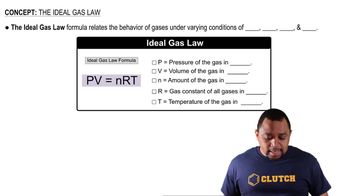
The Ideal Gas Law is a fundamental equation in chemistry that relates the pressure, volume, temperature, and number of moles of a gas. It is expressed as PV = nRT, where P is pressure, V is volume, n is the number of moles, R is the ideal gas constant, and T is temperature in Kelvin. This law allows us to calculate the amount of gas needed under specific conditions, such as Standard Temperature and Pressure (STP).
추천 영상:
가이드 코스
01:15
The Ideal Gas Law Concept 1

Standard Temperature and Pressure (STP)

Standard Temperature and Pressure (STP) is a reference point used in chemistry to define the conditions under which gas measurements are made. STP is defined as a temperature of 0 degrees Celsius (273.15 K) and a pressure of 1 atmosphere (101.3 kPa). At STP, one mole of an ideal gas occupies a volume of 22.4 liters, which is crucial for calculating the amount of gas required to fill a given volume.
추천 영상:
가이드 코스
00:33
Standard Temperature and Pressure Concept 1

Molar Mass of Hydrogen

The molar mass of hydrogen is the mass of one mole of hydrogen gas (H2), which is approximately 2 grams per mole. This value is essential for converting between the volume of hydrogen gas and its mass when using the Ideal Gas Law. Knowing the molar mass allows us to determine how many kilograms of hydrogen are needed to fill the balloon at STP based on the volume provided.
추천 영상:
가이드 코스
01:10
Calculating Molar Mass
관련 실천
교과서 질문

Indicate if pressure increases, decreases, or stays the same in each of the following:

a.

786
views

교과서 질문

A weather balloon is partially filled with helium to allow for expansion at high altitudes. At STP, a weather balloon is filled with enough helium to give a volume of 25.0 L. At an altitude of 30.0 km and –35 ⁰C, it has expanded to 2460 L. The increase in volume causes it to burst and a small parachute returns the instruments to Earth.

b. What is the final pressure, in millimeters of mercury, of the helium inside the balloon when it bursts?

2238
views
교과서 질문

A balloon is filled with helium gas with a partial pressure of 1.00 atm and neon gas with a partial pressure of 0.50 atm. For each of the following changes (a to e) of the initial balloon, select the diagram (A, B, or C) that shows the final volume of the balloon:

<IMAGE>

d. The Kelvin temperature doubles and half of the gas atoms leak out (P does not change).

1305
views
교과서 질문

What is the total pressure, in millimeters of mercury, of a gas mixture containing argon gas at 0.25 atm, helium gas at 350 mmHg, and nitrogen gas at 360 Torr?

819
views
교과서 질문

At a restaurant, a customer chokes on a piece of food. You put your arms around the person's waist and use your fists to push up on the person's abdomen, an action called the Heimlich maneuver.

b. Why does it cause the person to expel the food item from the airway?

768
views
교과서 질문

A mixture of nitrogen (N2) and helium has a volume of 365 mL at 30 °C and a total pressure of 745 mmHg. (8.5, 8.6, 8.7)

a. If the partial pressure of helium is 65 mmHg, what is the partial pressure of the nitrogen?

37
views