Ch.8 Gases
Timberlake - Chemistry: An Introduction to General, Organic, and Biological Chemistry 14th Edition
Timberlake14th EditionChemistry: An Introduction to General, Organic, and Biological ChemistryISBN: 9781292472249당신이 사용하는 게 아니라요?교과서 변경
8장, 문제 8d

On a climb up Mount Whitney, the atmospheric pressure drops to 467 mmHg. What is the pressure in terms of the following units?
d. Pa

검증된 단계별 안내
1
Step 1: Understand the relationship between mmHg and Pascals (Pa). The conversion factor is 1 mmHg = 133.322 Pa.
Step 2: Write the given pressure in mmHg, which is 467 mmHg.
Step 3: Set up the conversion equation using the conversion factor: \( P_{\text{Pa}} = P_{\text{mmHg}} \times 133.322 \).
Step 4: Substitute the given value of 467 mmHg into the equation: \( P_{\text{Pa}} = 467 \times 133.322 \).
Step 5: Perform the multiplication to calculate the pressure in Pascals (Pa).

비슷한 문제에 대한 검증된 영상 답변:

이 영상 해법은 위 문제에 도움이 된다고 튜터들이 추천한 것입니다.
영상 길이:
1m

주요 개념

질문에 올바르게 답하기 위해 반드시 이해해야 하는 핵심 개념들은 다음과 같습니다.

Atmospheric Pressure

Atmospheric pressure is the force exerted by the weight of air above a given point, typically measured in units such as mmHg, atm, or Pa. At sea level, standard atmospheric pressure is approximately 1013.25 mmHg. As altitude increases, such as on a climb up Mount Whitney, atmospheric pressure decreases due to the reduced weight of the air column above.
추천 영상:
가이드 코스
01:54
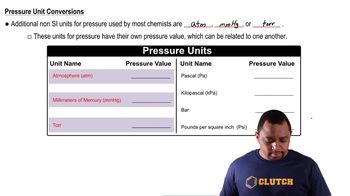
Pressure Units Concept 2

Unit Conversion

Unit conversion is the process of converting a quantity expressed in one set of units to another set of units. In this context, converting pressure from mmHg to pascals (Pa) involves using the conversion factor where 1 mmHg is approximately equal to 133.322 Pa. Understanding how to perform these conversions is essential for accurately interpreting measurements in different contexts.
추천 영상:
가이드 코스
01:56
Conversion Factors (Simplified) Concept 1

Pascals (Pa)

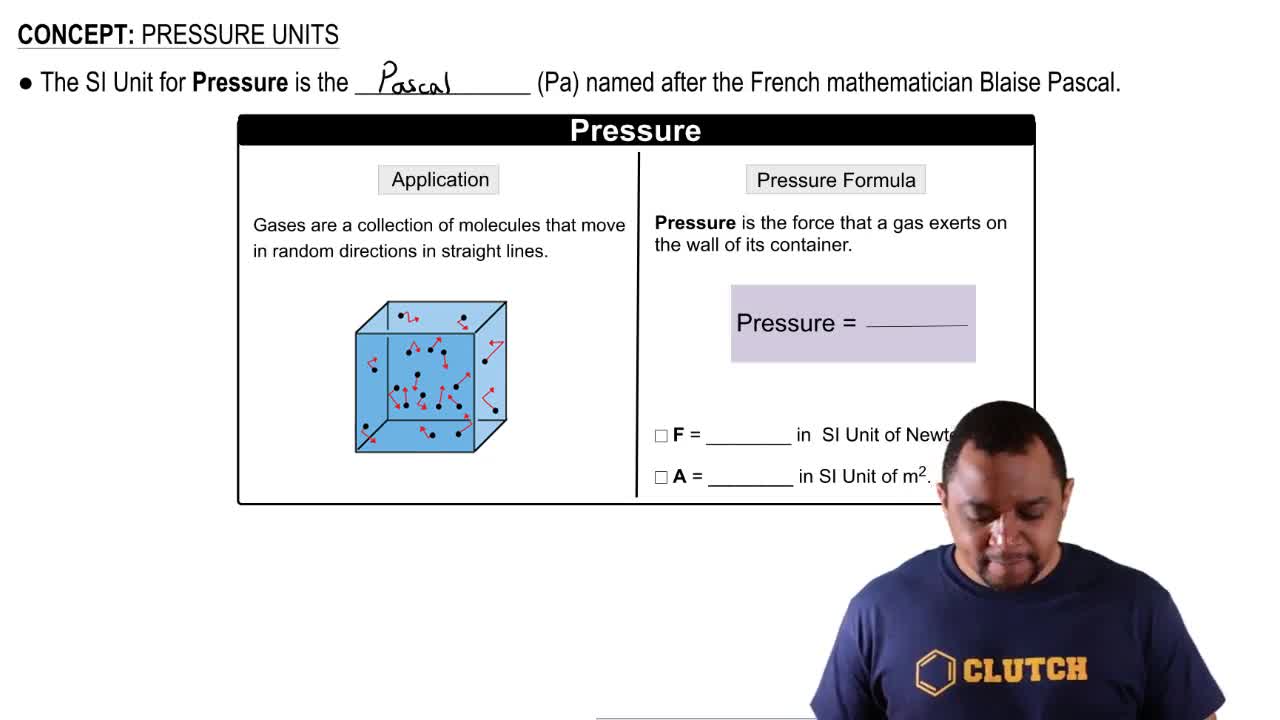
The pascal (Pa) is the SI unit of pressure, defined as one newton per square meter. It is a standard unit used in scientific contexts to express pressure, stress, and tensile strength. Knowing how to express atmospheric pressure in pascals is important for scientific calculations and comparisons, especially in fields like meteorology and engineering.
추천 영상:
가이드 코스
01:15
Pressure Units Concept 1