Ch.9 Solutions
Timberlake - Chemistry: An Introduction to General, Organic, and Biological Chemistry 14th Edition
Timberlake14th EditionChemistry: An Introduction to General, Organic, and Biological ChemistryISBN: 9781292472249당신이 사용하는 게 아니라요?교과서 변경
9장, 문제 27a

A solution containing 80. g of KCl in 200. g of H2O at 50 °C is cooled to 20 °C. a. How many grams of KCl remain in solution at 20 °C?

검증된 단계별 안내
1
Step 1: Understand the solubility concept. Solubility refers to the maximum amount of solute (in this case, KCl) that can dissolve in a given amount of solvent (H₂O) at a specific temperature. Look up the solubility of KCl at 20 °C in a solubility table.
Step 2: Compare the solubility of KCl at 20 °C with the amount of KCl initially dissolved (80 g). If the solubility at 20 °C is less than 80 g, the excess KCl will precipitate out of the solution.
Step 3: Calculate the amount of KCl that remains dissolved in the solution at 20 °C. Use the solubility value from the table to determine how many grams of KCl can stay dissolved in 200 g of water at this temperature.
Step 4: Subtract the solubility value (grams of KCl that can dissolve at 20 °C) from the initial amount of KCl (80 g) to find the amount of KCl that precipitates out. The remaining amount in solution will be equal to the solubility value.
Step 5: Ensure the units are consistent throughout the calculation. Verify that the solubility value corresponds to the same amount of water (200 g) as given in the problem. If necessary, adjust the solubility value proportionally to match the 200 g of water.

비슷한 문제에 대한 검증된 영상 답변:

이 영상 해법은 위 문제에 도움이 된다고 튜터들이 추천한 것입니다.
영상 길이:
2m
도움이 되었나요?

주요 개념

질문에 올바르게 답하기 위해 반드시 이해해야 하는 핵심 개념들은 다음과 같습니다.

Solubility

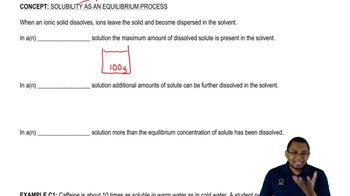
Solubility refers to the maximum amount of a solute that can dissolve in a solvent at a given temperature and pressure. For KCl in water, solubility changes with temperature; typically, as temperature decreases, solubility also decreases, meaning less solute can remain dissolved.
추천 영상:
가이드 코스
00:28
Solubility Rules

Temperature Effects on Solubility

The solubility of ionic compounds like KCl is significantly affected by temperature. Generally, higher temperatures increase solubility, allowing more solute to dissolve, while lower temperatures can lead to precipitation of the solute as it exceeds the solubility limit.
추천 영상:
가이드 코스
04:38
Solubility: Temperature Effect Concept 1

Saturation Point

The saturation point is the concentration of a solute in a solution at which no more solute can dissolve at a specific temperature. When a solution is cooled, if the concentration exceeds this saturation point, the excess solute will precipitate out of the solution.
추천 영상:
가이드 코스
03:05
Boiling Point Elevation Concept 1