Ch.9 Solutions
Timberlake - Chemistry: An Introduction to General, Organic, and Biological Chemistry 14th Edition
Timberlake14th EditionChemistry: An Introduction to General, Organic, and Biological ChemistryISBN: 9781292472249당신이 사용하는 게 아니라요?교과서 변경
9장, 문제 31d

Predict whether each of the following ionic compounds is soluble in water: d. CuO

검증된 단계별 안내
1
Step 1: Recall the solubility rules for ionic compounds in water. These rules help predict whether a compound will dissolve in water. For example, compounds containing alkali metal ions (e.g., Na⁺, K⁺) and ammonium ions (NH₄⁺) are generally soluble, as are nitrates (NO₃⁻), acetates (CH₃COO⁻), and most chlorides (Cl⁻), bromides (Br⁻), and iodides (I⁻).
Step 2: Identify the ions present in CuO. Copper(II) oxide consists of Cu²⁺ (copper ion) and O²⁻ (oxide ion).
Step 3: Check the solubility rules for compounds containing oxide ions (O²⁻). Oxides are generally insoluble in water, except for those of alkali metals and some alkaline earth metals (e.g., BaO).
Step 4: Determine if Cu²⁺ is an exception to the general insolubility of oxides. Copper(II) oxide does not fall under the exceptions for oxide solubility, as Cu²⁺ is not an alkali or alkaline earth metal ion.
Step 5: Conclude that CuO is generally insoluble in water based on the solubility rules and the nature of its ions.

비슷한 문제에 대한 검증된 영상 답변:

이 영상 해법은 위 문제에 도움이 된다고 튜터들이 추천한 것입니다.
영상 길이:
42s
도움이 되었나요?

주요 개념

질문에 올바르게 답하기 위해 반드시 이해해야 하는 핵심 개념들은 다음과 같습니다.

Ionic Compounds

Ionic compounds are formed when atoms transfer electrons, resulting in the formation of positively and negatively charged ions. These compounds typically consist of a metal and a non-metal, and their properties include high melting and boiling points, as well as electrical conductivity when dissolved in water or molten.
추천 영상:
가이드 코스
02:11
Naming Ionic Compounds

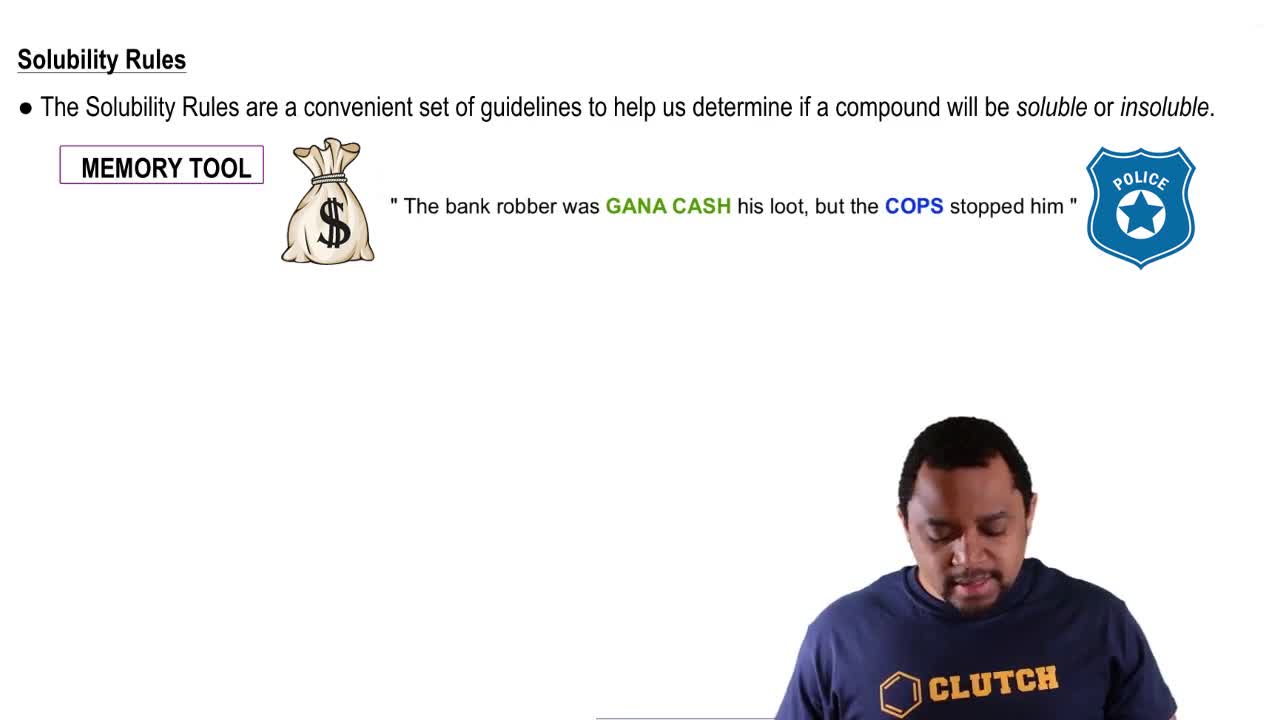
Solubility Rules

Solubility rules are guidelines that help predict whether an ionic compound will dissolve in water. These rules take into account the nature of the ions involved, with common soluble compounds including those containing alkali metals, ammonium, and nitrate ions, while many metal oxides, like CuO, are generally insoluble.
추천 영상:
가이드 코스
00:28
Solubility Rules

Copper(II) Oxide (CuO)

Copper(II) oxide (CuO) is a black solid that is an example of a metal oxide. According to solubility rules, most metal oxides are insoluble in water, which means that CuO does not dissolve in water, making it an important consideration when predicting the solubility of ionic compounds.
추천 영상:
가이드 코스
1:47
Oxidation of Monosaccharides Concept 1